


Slow, buggy apps lose users fast. Learn what mobile app automation testing covers, why it matters, and how automated testing improves mobile app performance, cuts costs, and speeds up time to market.

The market for mobile apps has become quite competitive. Mobile application testing is a must to ensure functionality, usability, reliability, and performance. Effective mobile app testing allows for early recognition of defects and enhances time to market.
People spend a large part of their day on mobile apps, so a great mobile app experience is essential. Before an application is released to the public, it must be tested to make sure it runs properly on iOS and Android.
In this guide, we'll go over the importance of mobile app testing and how automated testing helps you produce an application that is both responsive and functional.
What is a Mobile Application?
A mobile app is application software created specifically to run on mobile devices like smartphones and tablets. Because these devices vary in screen size, hardware, and network conditions, mobile apps need speed and usability testing to assess how they perform.
What is Mobile App Automation Testing?
Mobile automation testing is executed to ensure an application works correctly and as intended. Automated mobile app testing evaluates responsiveness, usability, and performance, and tests the system’s response on a variety of devices. Mobile automation testing ensures the following:
- App Functionality: Functional testing makes sure the mobile app meets all of the requirements listed in the design document.
- App Security: Security testing checks that the application and the data it stores are protected against malware and attackers.
- App Usability: Usability testing evaluates how easy and user-friendly the application is.
- App Performance: Performance testing establishes whether the application can handle heavy user traffic during peak periods. It analyzes aspects such as transaction failures, network use, and response times.
- App Accessibility: Accessibility testing makes sure the app is usable by people with varied abilities.
Automated mobile testing may also be supported by manual testing performed by humans who independently test the apps and look for any problems that a user might run into.
Automated mobile testing tools often support “record and playback” testing, which is a way to create tests without programming knowledge. You manually carry out tasks in the app while the tool records them and stores them as a test.
Regression testing becomes much faster because you can rerun the recorded test with just one click. As a result, manual testers and testers who are still learning automated testing tools can quickly write automated tests.
Automated mobile testing is beneficial for long-term projects, maintenance checks, smoke tests, regression tests, and continuous integration. Additionally, automation tools allow humans to focus on edge cases or exploratory testing.
Why Perform Automated Mobile App Testing?
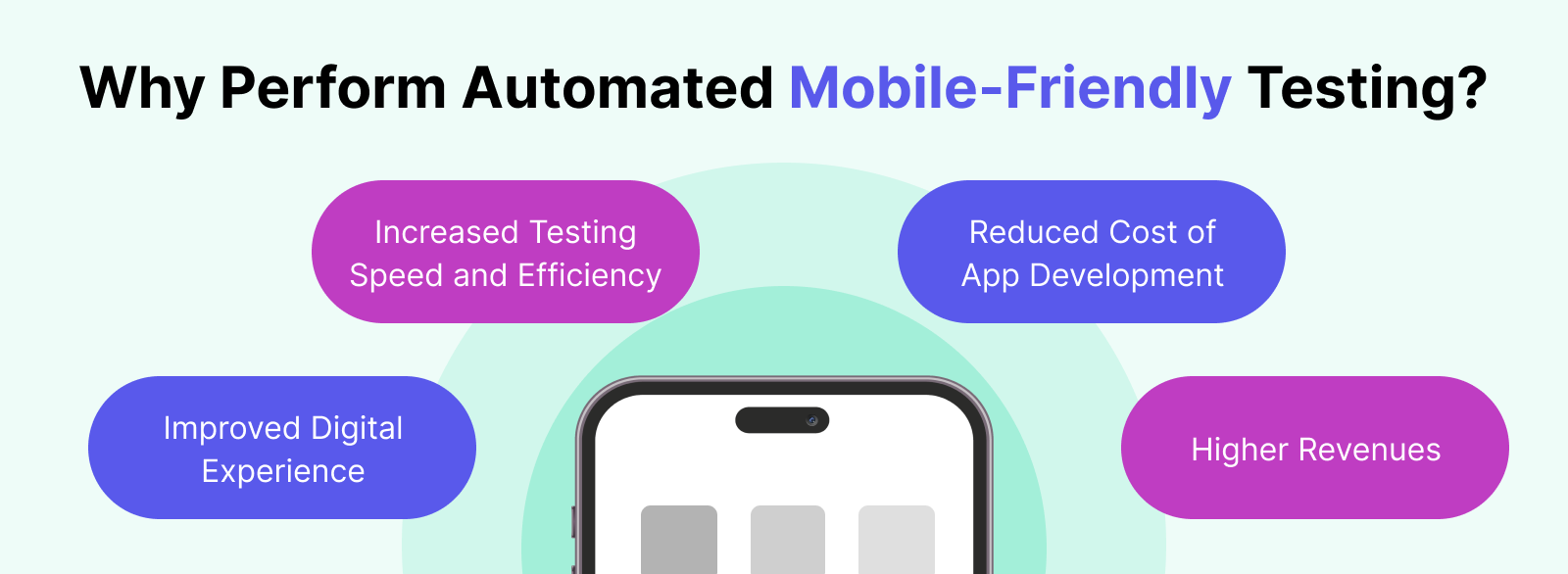
Testing an app keeps it in the game and at a competitive spot, so there is no room for error as the majority of mobile consumers will not overlook any inconveniences. A study from Google discovered that 39% of users abandon apps that exhibit technical problems, and many users will abandon an app entirely if there are slow load times, bugs, or security breaches.
It is necessary to build a responsive, user-oriented application that is compatible with all devices. Mobile application automation testing streamlines the entire testing process, speeding up the feedback loop and allowing faster application development.
Here are some of the advantages of mobile app automation testing:
1. Increased Testing Speed and Efficiency
Thanks to automation, mobile app testers can run more tests in a shorter amount of time. For example, whenever a change is made, test cases may be stored and rerun. Test automation allows app developers to add more features without negatively influencing the duration and expense of app testing.
2. Reduced Cost of App Development
Automated app testing can lower the project's cost by saving time. The true cost reductions, however, come from extensive testing, which lowers the likelihood of faults being discovered after deployment. Plus, automated testing tools have the ability to schedule tests, meaning test cases can run overnight.
3. Improved Digital Experience
Mobile app performance testing improves the digital experience for end users. When optimal functioning and usability are guaranteed, users are more likely to be satisfied. Your app will impress users from their first touchpoint. If customers are satisfied, it builds trust and loyalty and allows you to develop a good reputation.
4. Higher Revenues
Mobile app automation testing decreases the risk of any issues and having to redevelop your app at the final stage. This saves you time and money, bringing in higher revenue in the long run.
The easiest method to achieve these advantages, like increased productivity and efficiency, and make efficient use of resources and time is to implement test automation for your mobile application development process.
Even if you add one new feature to your application, existing features need to be retested to guarantee consistent performance and user experience. Automating these regression checks frees manual testers to focus on more critical areas.
Why Choose Automated Testing to Improve Mobile Application Performance

Let's examine how test automation offers considerable benefits.
1. Cost and Time-to-Market
Automated mobile-friendly testing provides a high return on investment (ROI) due to test reusability. Tests can be completed at no additional cost and at a faster rate.
2. Reliability
Automated testing will speed up development cycles, prevent tiresome repetition activities, and enhance the quality of your program. You can benefit from automation testing if the test is highly repetitive and takes up a lot of time, as is the case for regression testing. Manual testing complements automation testing by finding problems from the user's point of view and unanticipated defects from unscripted settings.
3. Improve Effectiveness
A professional mobile automated testing tool increases test efficiency and effectiveness and helps produce high-quality, reliable software. Automated testing can cut regression cycles from days to hours, freeing your team to ship faster.
Automate Mobile Testing with Katalon
Katalon’s automated testing platform is suited for mobile applications and is built for continuous testing for any team, at any level. Katalon ensures your application will function properly throughout its customer experience journey.
Katalon True Platform is an end-to-end software quality platform that offers fast test creation, object spying utilities, image-based testing, cross-environment execution on real devices, simulators, or cloud-based devices, and more.
Frequently asked questions
A mobile app is software built to run on mobile devices like smartphones and tablets, often needing speed and usability testing to assess performance.
It uses automated tests to validate responsiveness, usability, and performance across devices, covering areas like functionality, security, usability, performance under heavy traffic, and accessibility.
It supports competitive quality by speeding up the feedback loop, helping ensure compatibility across iOS and Android, and reducing the risk of users abandoning apps due to slow load times, bugs, or security issues.
Increased testing speed and efficiency (rerun stored tests after changes), reduced development cost (catching faults earlier and running scheduled tests overnight), improved digital experience, and higher revenues by reducing late-stage redevelopment risk.
For long-term projects, maintenance checks, smoke tests, regression tests, and continuous integration—while manual testing can complement automation with exploratory and unscripted, user-perspective checks.





Test everything. Ship with confidence.
From generating test cases to spotting failures, Katalon's AI works across your entire pipeline, automatically.
