


DevTestOps adds continuous testing to DevOps so testers work alongside developers from day one. Learn what DevTestOps is, why it matters for agile teams, how Spotify applies it, and the tools and practices to get started.
The three key positions in a software development team are developer, tester, and operations. Required tasks among these positions are continuously reinvented.
To speed up the development process, development and operations were integrated, which is now referred to as DevOps. Unfortunately, a critical layer between Dev and Ops was overlooked: the fixed cycle of testing. To ensure swift turnaround, improve overall efficiency, and maintain the continuous status for testing in the DevOps cycle, a new methodology has evolved: DevTestOps.
What Is DevTestOps?
In essence, DevTestOps is a combination of DevOps and continuous testing. Testing early, regularly, and across the software delivery pipeline are all methods that are used during the software testing process.
In DevTestOps, continuous testing is built into the CI/CD pipeline. This practice gives developers continuous testing feedback throughout product development, which reduces business risk and the chance of discovering defects late.
DevTestOps: A New Manifesto for Agile
DevTestOps has ushered in a new era of development, upending the practice of testing only after code is complete.
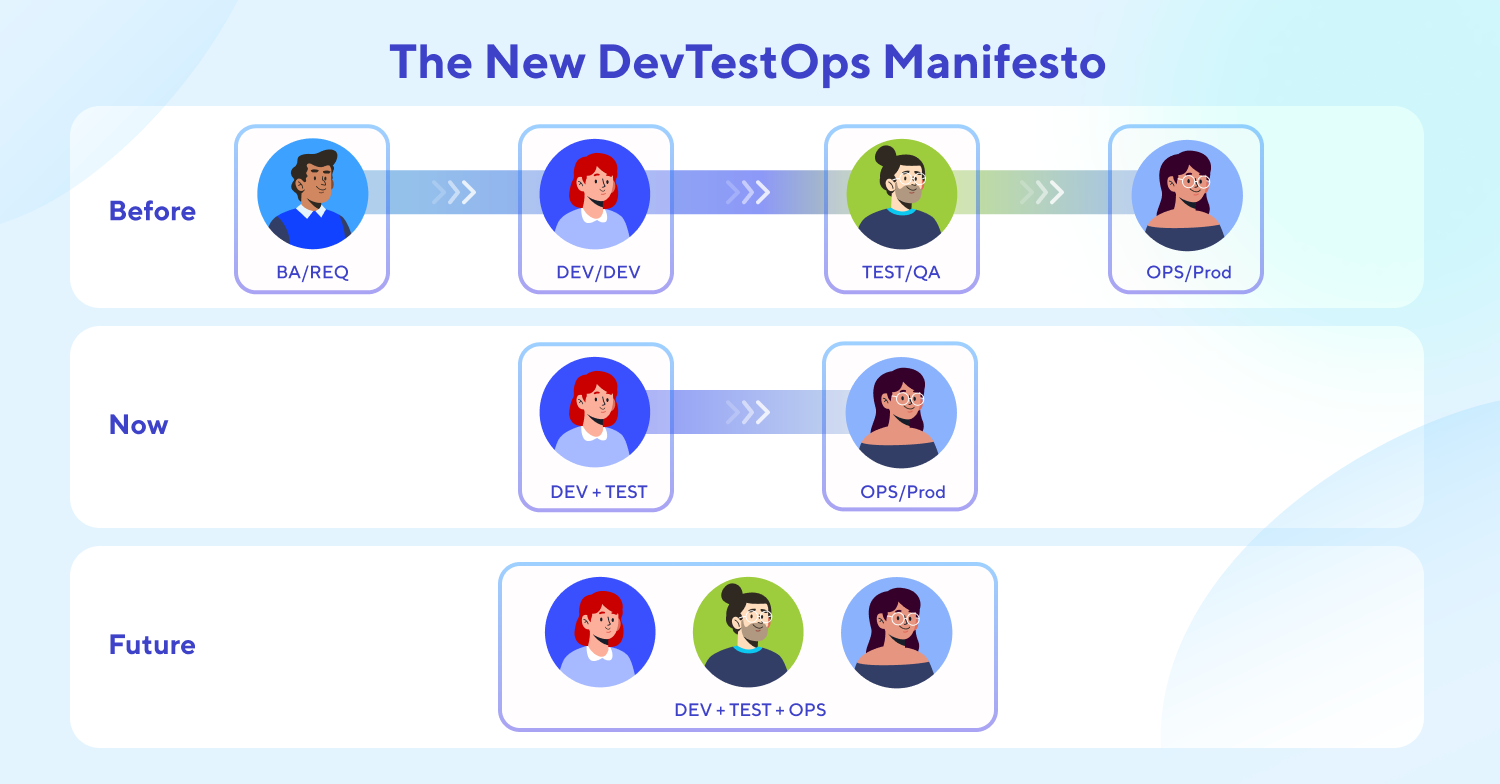
Continuous testing changed how teams ship, because it aids early product feedback and allows for early problem detection, which ultimately helps to reduce the costs associated with fixing issues after the fact.
In the traditional software development life cycle (SDLC), testing is done at the end of the development cycle when the entire product is complete. This creates a delay between writing code and finding and fixing errors. The more new code has been built on top of a defect, the harder, slower, and more costly it is to find and fix.
However, many firms have begun to “shift left,” testing much earlier in the development process. Testing and QA professionals emphasize that testing should be part of every discussion, from building a common understanding of new features to planning the delivery pipeline and monitoring production use.
Testing as early as possible is essential for agile teams that want to move into the fast lane, and DevTestOps makes that possible.
Read More: How to apply Agile methodology to streamline your testing process
Why Developers and Testers Clash, and How DevTestOps Helps
Developers build the software, and testers look for the ways it can fail. When testers only see the code after it's finished, the same loop repeats: bugs are logged late, fixes take longer, and each side sees the other as the bottleneck.
Letting developers test only their own code doesn't fix it. Authors are prone to inattentional blindness: they know what the code is meant to do, so they overlook where it doesn't. A tester's independent view is what catches those gaps.
NASA's Mars Climate Orbiter shows what late collaboration costs. The spacecraft was lost in 1999 because one team's software used imperial units while another expected metric. Agreeing on the units at the start would have saved the mission.
In DevTestOps, testers join from the start, including:
- Stakeholder and client meetings
- Writing user stories
- Functional and non-functional requirements
- Splitting work into tasks and enhancements
From DevTestOops to DevTestOps: Accelerating Your Agility
Spotify offers a real-life example of what a DevTestOps-style approach to scaling an agile team looks like. As one of the world’s largest audio streaming services, Spotify credits much of its delivery speed to how its teams share responsibility for quality.
Spotify’s model is well established and people-driven. It emphasizes the internal network, communication, and, most importantly, shared responsibility for quality across all teams, from developers to testers and operations. With testing built into every stage as a must-do process in all departments, Spotify team members are equally accountable for the end-to-end product.
In Spotify’s model, developers code new product features, such as playlist personalization or song shuffle. CI tools integrated into the workflow test every new code iteration, reducing the chance of introducing errors. If a test fails, developers can fix the build before it goes to deployment. Because defects are caught and fixed early, developers ship with more confidence and spend less time on rework.
Moreover, QAs/testers perform testing and design test scenarios to detect any errors that need to be addressed, such as a non-clickable button on the website or if the music abruptly stops playing. With major code bugs fixed in the earlier stage, QAs can now focus on other parts of the code that are naturally isolated and have their own internal complexity. Additionally, with continuous testing, QAs can monitor and handle a larger volume of data, thanks to automated log parsing. Subsequently, Continuous Integration (CI) build log files are parsed automatically to provide fast and accurate feedback, from application requests to error messages.
Think of continuous testing (CT) as a good habit in your daily routine. Just as drinking enough water every day keeps you healthier, continuous testing makes your workflow more agile by building bug detection into the routine, speeding up development, and keeping both Devs and Ops informed with up-to-date data. Adding continuous testing to your DevOps cycle (DevTestOps) also ensures the right test infrastructure, platforms, and frameworks are available and configured before testing begins. Learn more about shift-left testing. Some of the benefits are:
- Defects are identified early, so they are easier to fix
- Automation can shorten regression cycles dramatically
- Developers and testers work together more regularly to improve product quality
- Automated builds and deployments reduce human error and manual dependencies
Building the DevTestOps Toolchain
Every commit should trigger automated unit, integration and regression tests in CI, so most regressions are caught before a build reaches QA. That frees testers for exploratory testing and harder scenarios.
Open-source tools are free but take programming skill to set up, integrate with CI/CD and maintain. Commercial tools cost license fees but are ready to use and come with support. Most teams mix both. Common choices by test type:
- Unit testing: xUnit, Jest, Mocha
- Static code analysis: SonarQube
- API testing: Postman, SoapUI
- End-to-end testing: Katalon Studio, Selenium, Playwright
- Test reporting and management: Katalon TestOps, Allure, ReportPortal
DevTestOps Practices for Agile Teams
- Test microservices independently. Smaller services mean smaller builds and faster test feedback. Integration and acceptance tests across services need the most attention, so testers should understand the architecture.
- Let developers run quick smoke tests before handover. A recorded or low-code smoke test of the key flows, run against each build, stops broken builds from reaching the QA environment.
- Share tests both ways. Testers pass on the mistakes they see most and give developers reusable end-to-end tests. Developers explain the code's internal logic so testers can find edge cases.
- Keep results in one place. Bring CI results, test reports and defect status together, so both teams look at the same picture.
Nevertheless, adopting DevTestOps to the fullest is not an easy task. Developers need to adjust to a new method of working, in which code testing is also their responsibility. QAs/testers are more involved and provide their knowledge, which helps teams create appropriate tests and makes the process more efficient. The operations team must now ensure that there are no mismatches between development and staging environments.
To kick-start DevTestOps, everyone on the team must be on the same page and understand that testing happens throughout the entire workflow. Learn why it pays to invest in DevOps orchestration.
The Next Step: How Katalon Can Help
To fast-track your DevTestOps approach, teams pair Katalon Studio for test automation with Katalon TestOps for test management and reporting. Here’s how each one helps:
Studio:
- No-code, low-code, and full-code test authoring in one IDE
- Keyword-driven testing and self-healing mechanisms that streamline automation and reduce maintenance
TestOps:
- Shift-left testing through a centralized, collaborative dashboard where all teams can join the testing cycle early, speed up debugging, and get bug alerts
- Integrations with mainstream CI/CD platforms such as Jenkins, Azure DevOps, and CircleCI
To see how these integrations work in practice, especially with Azure DevOps, explore our Katalon Studio + Azure DevOps webinar, which walks through native connections with Azure Pipelines, Repos, and Test Plans.
What works for one company won't fit every team. Start small, prove the approach on one product, then extend it across your pipeline with Studio and TestOps.
Frequently asked questions
DevTestOps is a combination of DevOps and continuous testing. Instead of testing only after the code is complete, teams test early, regularly, and across the whole software delivery pipeline, with a CI/CD pipeline built into the continuous testing setup. Developers get testing feedback throughout development, which lowers the chance of finding defects late.
DevOps brought development and operations together to speed up delivery, but it overlooked the fixed testing cycle between them. DevTestOps adds continuous testing to the DevOps cycle, so testing happens at every stage instead of as a separate step at the end.
From the start. In DevTestOps, testers join stakeholder and client meetings, help write user stories, review functional and non-functional requirements, and help split work into tasks and enhancements. Their independent view catches gaps that developers tend to miss when they test their own code.
Test microservices independently, since smaller services mean smaller builds and faster test feedback. Share tests both ways: testers pass on the mistakes they see most and give developers reusable end-to-end tests, while developers explain the code's internal logic so testers can find edge cases. Keep CI results, test reports, and defect status in one place, so both teams look at the same picture.
Most teams mix open-source and commercial tools. Common choices are xUnit, Jest, or Mocha for unit testing; SonarQube for static code analysis; Postman or SoapUI for API testing; Katalon Studio, Selenium, or Playwright for end-to-end testing; and Katalon TestOps, Allure, or ReportPortal for test reporting and management.
Developers have to adjust to a way of working where testing their code is also their responsibility, and testers get involved much earlier. The operations team must make sure there are no mismatches between development and staging environments. A practical way in is to start small, prove the approach on one product, then extend it across your pipeline.




Test everything. Ship with confidence.
From generating test cases to spotting failures, Katalon's AI works across your entire pipeline, automatically.
