


As QA processes mature, testers must evolve too. Drawing on a survey of 1,400 QA professionals, this article shows where teams sit on the maturity curve and how hybrid testers help organizations move up it.
The “organic” evolution of a software tester should follow the organic evolution of an organization’s QA maturity.
A tester can be conveniently imagined as an organism existing within a larger ecosystem (in our case, the organization). An organism does not exist in isolation. Rather, it responds to, adapts to, and evolves along with the environment in which it finds itself.
Similarly, if a QA system matures, with increasingly high levels of automation and integration, the tester must also “mature” accordingly. They must go from being a manual, ad-hoc tester, to an automation tester, to a hybrid tester with a diverse set of skills.
From Low QA Maturity to High QA Maturity
At organizations with low QA maturity, testing is usually seen as a cost center rather than a value-generating activity. In the early days, testers were only involved at the very end of the development cycle.
They had to test everything manually in an incredibly tight time frame. As a result, if a bug is found, the devs don’t have enough time to troubleshoot, and chaos inevitably ensues.
Thankfully, Agile arrived. Shift-left testing emerged. Automation testing tools came into play. Manual testers were saved.
But are they actually saved?
Let’s take a look at the QA maturity curve. We surveyed 1,400 QA professionals in the State of Software Quality Report 2025 and found that a staggering 26% of them are still operating in the initial area of QA maturity. In these organizations, they have an informal or unstructured testing process, with minimal automation.
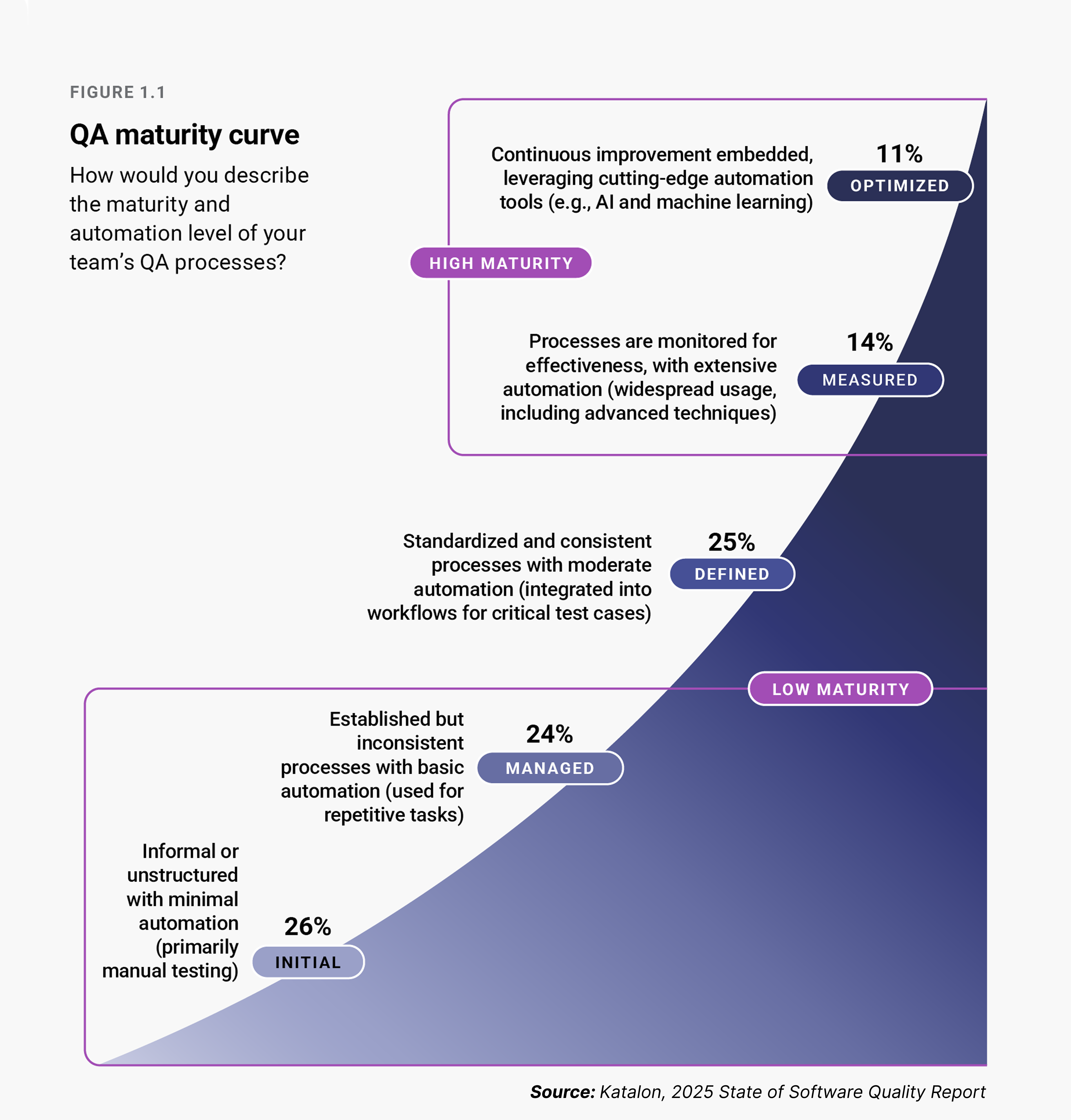
24% have more established but still inconsistent processes with basic automation.
25% have more defined processes with moderate automation. 14% of them are in the measured stage with proper result tracking and extensive test automation.
Only 11% reach the maturity level of optimized, where they have continuous improvement deeply embedded into the processes while using advanced automation tools.
And that is happening even within large companies.
We filtered the data, leaving only the big companies. Surprisingly, only 34% of companies with > 1,000 employees have reached advanced maturity.
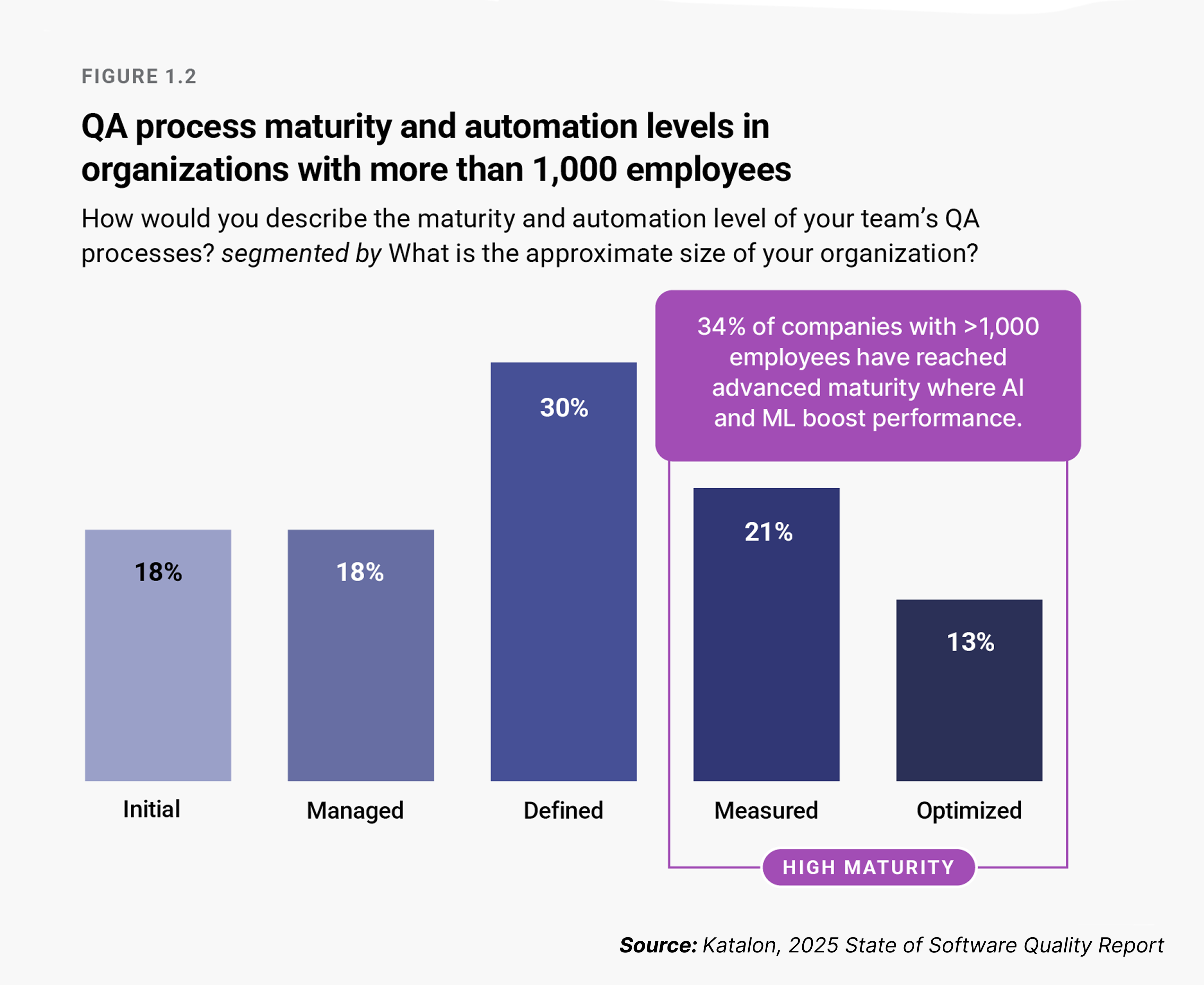
It is evident that there is still a lot of untapped potential to further improve efficiency in the QA process.
Returning to the organism analogy, if the tester (the organism) can evolve to a certain level, it can start to influence, modify, and shape the environment it is in.
This is when the hybrid tester takes the stage.
From Manual Testers to Hybrid Testers
Hybrid testing is more than just a methodology. It’s a shift in how testing is managed in an AI-driven world. Testers now use AI-powered tools to optimize test creation, execution, and maintenance while applying human judgment to validate AI-generated tests.
Those who do that are called hybrid testers. They are:
- Adaptable
- Proactive learners
- Strategic thinkers
Hybrid testers do get the best of both worlds. Knowing both sides of testing is their competitive edge.
Testing has been, and will always be, a creative art. It takes a certain kind of person to start an application and interact with it in unimaginable ways to find unimaginable bugs. It also takes effort to equip oneself with the technical and domain knowledge to write automation scripts that can speed up the process.
When you combine the unique and sometimes cynical outlook of an exploratory tester with the technical know-how of an automation tester, all supported by the generative capabilities of LLMs, you get a unique breed of testers who can raise the QA maturity of the whole organization.
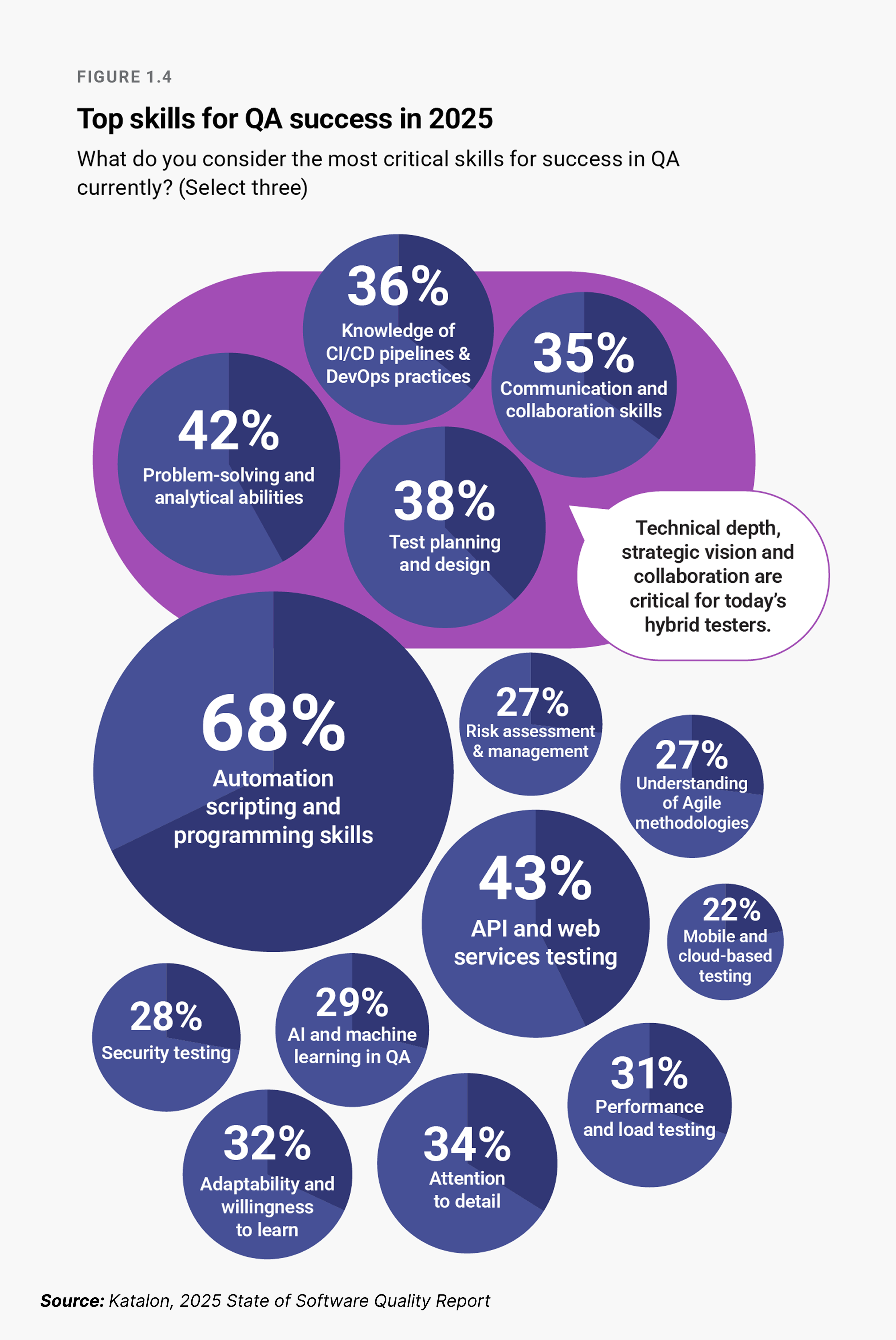
How Hybrid Testers Can Be a Catalyst for QA Maturity
- Hybrid testers bring a higher level of expertise to the table. Their automation skills allow them to write scripts that integrate smoothly with CI/CD pipelines to check code quality faster.
- Hybrid testers’ automation capabilities encourage TDD and BDD to ensure code is testable from the start. This creates stronger tester-dev relationships as well as stakeholder relationships, which ultimately translates into better transparency across the entire organization.
- The biggest ROI of automation testing is found in regression testing. Google is a well-known example: as features grew more complex, manual testing delayed release cycles, so the company invested heavily in automated testing to keep shipping quickly.
- At the same time, the hybrid tester’s exploratory testing skills allow them to look for the more elusive, “hidden” bugs that automation testing can’t find. This improves overall test coverage.
How to Build a Team of Hybrid Testers
If you are a QA leader looking to transition your team into hybrid testers, here’s a roadmap:
- Identify skill gaps: Assess your team’s current strengths in manual and automation testing. Identify their current skill level and the skill level they should grow into.
- Provide hands-on training: Offer structured learning paths in automation tools (Selenium, Katalon, Cypress) and testing approaches (TDD, BDD). Encourage them to practice with small-scale, real-world projects to hone their skills.
- Encourage a shift-left mindset: Get testers involved earlier in the development cycle. Promote collaboration with developers to ensure testability is built into the code.
- Use AI and LLMs: Introduce testers to AI-powered tools that assist in test case generation, log analysis, and test optimization to improve efficiency.
More Insights in the State of Software Quality Report 2025
We surveyed 1,400 QA professionals around the world for the report, and this article draws on those findings.
What else you can find in the report:
- The rise of hybrid testers and the skill set they need
- Job satisfaction of testers
- The rise of AI in testing
- Challenges in scaling QA practices in an organization and how to overcome them
- Speed vs. quality in software development
- QA leadership
- Strategic drivers in modern QA
Read the full State of Software Quality Report 2025 for the complete findings.

Frequently asked questions
A hybrid tester combines strong exploratory and manual testing skills with automation and AI-assisted capabilities. They use tools, write scripts, and work with LLMs while still applying creative, user-focused thinking to uncover complex bugs.
QA maturity moves from informal, low-automation processes to more defined and measured stages with increasing automation, and finally to optimized practices where continuous improvement and advanced tools are deeply embedded—yet only a small percentage of organizations reach this highest level.
Hybrid testers can influence and shape their environment by integrating automation into CI/CD, promoting TDD and BDD, strengthening collaboration with devs and stakeholders, and combining regression automation with exploratory testing to achieve high coverage and faster cycles.
Leaders should help testers close gaps between manual and automation skills, provide hands-on training with tools like Selenium, Katalon, or Cypress, encourage shift-left collaboration, and introduce AI/LLM-based tools for test generation, log analysis, and optimization.
The report, based on insights from 1,400 QA professionals, highlights the rise of hybrid testers, outlines the skills they need, and explores topics like AI in testing, scaling QA, speed vs. quality, and QA leadership, showing how these roles connect directly to modern QA strategies.





Test everything. Ship with confidence.
From generating test cases to spotting failures, Katalon's AI works across your entire pipeline, automatically.
