


Test coverage measures how much of your software your tests actually exercise. Learn the key metrics, techniques, and best practices to improve it.
Test coverage measures how much of your software your tests actually exercise: code, requirements, and user flows. It shows what's been tested and, more usefully, what hasn't.
This guide covers the main coverage metrics, the techniques that raise coverage, and how to report it without chasing 100%.
Importance of test coverage in software quality assurance
Software failures cost more every year, and release cycles keep getting shorter. Coverage tells you whether testing is keeping up.
As a metric, test coverage shows how much of the codebase your tests evaluate. Teams use it to see which parts of the application have been tested and, more importantly, which have not.
Good coverage gives the team confidence to release. It's also a quick signal of how mature the QA process is.
Challenges in achieving comprehensive test coverage
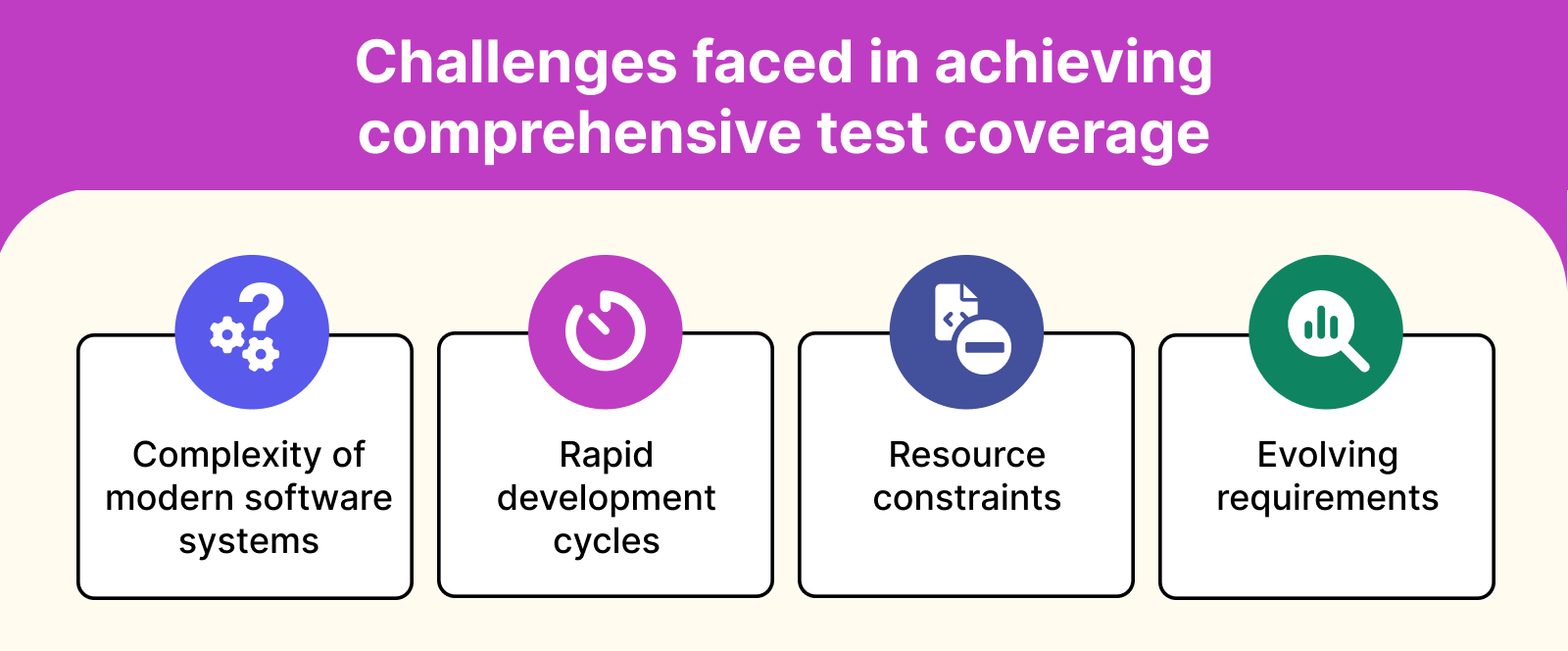
Full coverage is hard to reach. Four things usually get in the way.
Complexity of modern software systems
Modern systems are built from many connected parts: third-party services, microservices, and dynamic user interfaces. That makes it hard to test every interaction and data flow.
Rapid development cycles
Agile and DevOps speed up delivery, but they also squeeze testing time. Without automation and good test planning, coverage becomes the bottleneck.
Resource constraints
QA teams often have tight deadlines for large releases. They have to choose between testing critical features deeply or spreading effort thinly across the whole app.
Evolving requirements
Agile teams change requirements often. Every change means reviewing, and often expanding, the test suite.
Real-world impact of inadequate test coverage
Consider the case of Knight Capital Group. In 2012, a software glitch in its trading system lost $440 million in less than an hour. The cause was an old, unused function that was accidentally reactivated and never properly tested. Good coverage isn't only about finding bugs in new code. It's about knowing what every part of the system does.

The $440 Million Bug- Knight Capital Swamped by Glitch Loss (Credit: Bishr)
Practical strategies for optimizing test coverage
These 6 strategies help you raise coverage where it matters.
1. Prioritize testing efforts based on risk
Risk-based testing puts your most critical components first, so they get the most thorough checks.
2. Use automation to extend test coverage
Manual testing takes time and often becomes a bottleneck in Agile and DevOps teams. Automating repetitive tests extends coverage without slowing releases.
3. Implement continuous testing
Continuous testing runs tests at every stage, from development to deployment. Testing keeps pace with development, and developers get feedback right away.
4. Use test coverage metrics and tools
Coverage metrics give you a number for how much of the software has been tested, so you can track it over time.
5. Incorporate feedback loops
User feedback shows where testing falls short. Feed it back into your test plan, and focus on the areas that affect users most.
6. Use specialized tools and frameworks
Tools like Katalon Studio let you create, run, and manage automated tests for web, API, mobile, and desktop apps in one place. That makes consistent coverage across platforms easier to reach.
Advanced test coverage techniques
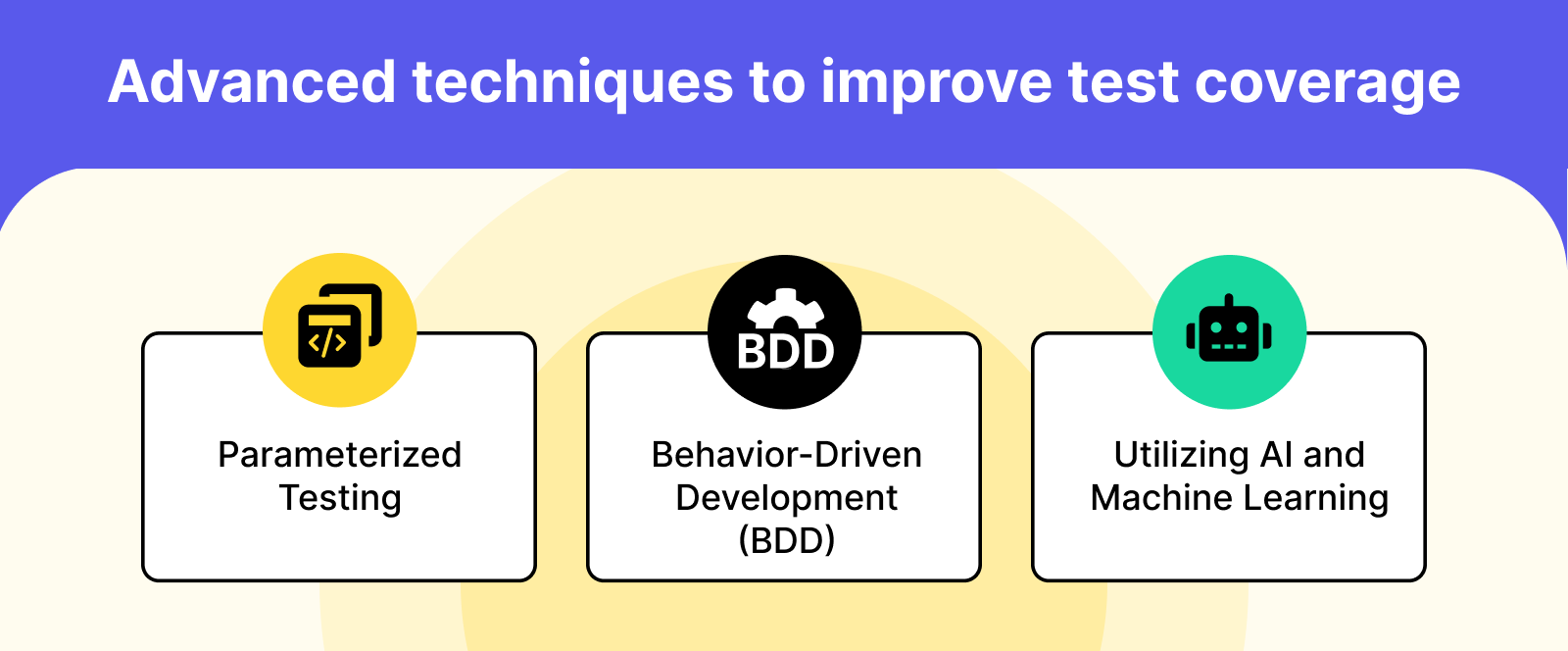
Once the basics are in place, these techniques widen coverage further.
Parameterized testing
Parameterized testing runs the same test case with different inputs, so you cover more without writing more tests. Automated, it can work through a large range of inputs and catch issues a single test would miss.
Behavior-Driven Development (BDD)
Behavior-driven development defines test scenarios in plain language, based on how users expect the software to behave. Developers, testers, and business stakeholders can all read them, so everyone agrees on what needs testing.
Utilizing AI and Machine Learning
AI and machine learning in testing can widen coverage. Machine learning models can generate test cases from code changes and real user behavior.
Implementing test coverage best practices
Put these practices in place to keep coverage high as your product grows.
Integrate test coverage early and often
Start test planning as early as possible, and involve QA from project kickoff. Issues found early are easier and cheaper to fix.
A clear test management process keeps test plans, cases, and results in one place, so the whole team can see what is covered and what still needs work.
Make test coverage a collaborative effort
Coverage isn't only QA's job. Developers can write unit tests and review code with testing in mind. Product managers can write clear requirements and acceptance criteria that guide what gets tested.
Use test coverage metrics wisely
Coverage metrics show how much you've tested, but they aren't a measure of success on their own. Use them to find gaps, not as a target. Chasing 100% coverage wastes effort and doesn't guarantee quality. Martin Fowler makes the same point: coverage is best used to find untested code. Focus on critical paths first.
Coverage is only one signal. Our list of test automation metrics covers the others worth tracking.
Continuously refine and optimize test cases
Review your test cases regularly. Remove outdated tests, update tests for new features, and look for ways to cover more scenarios with fewer tests.
Use automation for efficiency
Automation extends coverage most in regression testing. Automate repetitive, time-consuming tests, and spend the time saved on complex scenarios.
Embed testing within the CI/CD pipeline
Add automated tests to your CI/CD pipeline. Every commit gets tested automatically, so problems surface and get fixed faster.
Measuring and reporting test coverage effectiveness
These are the metrics that matter, and how to report them.
Requirement coverage
Requirement coverage shows how many of your functional and non-functional requirements, and user stories, are verified by tests.
A traceability matrix maps each requirement to the tests that verify it, which makes gaps in requirement coverage easy to spot.
Test case effectiveness
Test case effectiveness shows how good your tests are at finding defects. Measure it with the defect detection ratio: defects found compared with the total number of test cases. A high ratio means well-designed tests.
Automated vs. manual test coverage
This metric shows the share of tests that are automated versus run by hand. It helps you keep the balance right.
Reporting test coverage
Report coverage in a clear, simple format. Dashboards can pull data from several sources into one real-time view. Good reports show both strengths and gaps, so you know where to focus next.
To measure test coverage effectively, teams should:
- Use tools that generate coverage metrics automatically during test runs.
- Review coverage reports regularly to spot trends and gaps.
- Share findings openly with stakeholders, so everyone has the same picture of quality.
Katalon for test coverage management
Katalon Studio and Katalon TestOps cover the workflow from creating tests to reporting on them.
Simplifying test creation and execution
Katalon Studio offers no-code, low-code, and full-code test creation, so testers with any level of coding skill can contribute.
Enhanced test coverage through integrations
Katalon integrates with CI tools like Jenkins, source control like Git, and defect trackers like Jira.
Comprehensive testing capabilities
You can test web, API, mobile, and desktop apps in one tool, so coverage doesn't stop at platform boundaries.
Advanced insights and analytics
Katalon TestOps gives you real-time insights into test execution results, including pass and fail rates and release readiness, so you can track progress toward your coverage goals.
Collaboration and scalability
Teams can share test cases and results easily, so everyone works from the same information.
Conclusion
Coverage is a guide, not a target. Focus it on critical paths, automate the repetitive checks, run tests in your pipeline, and review the gaps every release.
Frequently asked questions
They’re methods to measure how much of the software has been tested, using lenses like code coverage, requirements coverage, and risk-based coverage.
Because it gives a quantifiable view of what’s been tested vs. what hasn’t, helping teams build confidence in reliability, functionality, stability, and user experience—especially as systems get more complex and release cycles speed up.
The guide highlights big obstacles: system complexity (microservices, third parties, dynamic UIs), rapid Agile/DevOps cycles, resource constraints, and evolving requirements that constantly force test-suite updates.
Key strategies include risk-based prioritization, automation to extend coverage, continuous testing across the SDLC, using coverage metrics/tools, and adding feedback loops from users to focus on what impacts them most.
The article calls out parameterized testing, BDD (behavior-driven development), and AI/ML-assisted test generation, plus best practices like starting coverage early, making it collaborative, embedding tests in CI/CD, and using coverage metrics wisely (not blindly chasing 100%).





Test everything. Ship with confidence.
From generating test cases to spotting failures, Katalon's AI works across your entire pipeline, automatically.
