


Autonomous testing is software testing in which AI agents decide and carry out testing actions, such as navigating an app, running test steps and judging results, while people set the goals, review the evidence and own the decisions that carry business risk.
The term gets stretched in every direction. Some vendors use it to mean "no humans needed." Others use it for any test that has AI somewhere in the loop. This guide sets out what it means in practice, how much autonomy is useful today, and how to tell whether a tool's results deserve your trust.
What Is Autonomous Testing?
Autonomous testing is testing where an AI agent decides how to carry out each step and then does it. The agent reads a goal or a test case, works out which screen to open, which field to fill and what to click, then compares what happened with what should have happened. People decide what gets tested and what a failure means for the release.
Compare that with test automation. An automated test follows a script someone wrote: find this locator, type this value, assert this text. If the script is wrong or the UI moves, the test breaks. An autonomous agent works from intent, so it can find the login button after a redesign without anyone editing a locator.
Why the Term Is Confusing
Three words get used as if they mean the same thing:
- AI-powered testing usually means a tool with AI features inside, such as test case suggestions or smarter locators. A person still drives the work.
- Agentic testing describes AI agents that plan and take actions toward a goal, often with tools and memory. It overlaps heavily with autonomous testing; see the FAQ below and What Is Agentic QA?
- Autonomous testing describes how much of the testing decision the machine takes on. It's a question of degree, which is why it's best explained as a set of levels.
A smaller group uses the term for something else entirely. Antithesis, for example, uses "autonomous testing" for computer-generated tests that explore distributed systems for bugs. That's a valid use, but it's not the one this page covers. Here, autonomous testing means AI agents carrying out functional testing of web, mobile and API applications.
Autonomous Testing vs. Automated Testing vs. Manual Testing
The difference is who decides each step. In manual testing a person decides and acts. In automated testing a person decides, in advance, and a script acts. In autonomous testing the agent decides how to act within a goal a person set, and leaves evidence for each decision.
Aspect | Manual testing | Automated testing | Autonomous testing |
|---|---|---|---|
Who decides each step | The tester, in the moment | The script author, in advance | The agent, at run time, within the goal |
Who carries it out | The tester | A script or framework | The agent |
Input | Test case or charter | Code, keywords or recorded steps | Natural-language test case or goal |
When the UI changes | Tester adapts | Test breaks until someone fixes it, unless self-healing catches it | Agent adapts and flags what changed |
Evidence you get | Tester's notes and screenshots | Pass or fail, logs, sometimes a screenshot on failure | Per-step verdict with screenshots, video and the agent's reasoning |
Speed at scale | Slow; limited by people | Fast once built | Fast, without building a framework first |
Upfront effort | Writing test cases | Writing and maintaining scripts | Writing clear test cases with expected results |
Best fit | Exploratory, usability, judgment calls | Stable, high-volume regression | Regression suites written as manual tests; flows that change often |
None of these replaces the others. Most teams will run all three, with each doing the work it's best at.
The Levels of Autonomous Testing (ASTM)
Autonomy in testing comes in six levels, from Level 0 (fully manual) to Level 5 (fully autonomous). Katalon defined these levels in 2022 as the Autonomous Software Testing Model (ASTM), based on SAE J3016, the standard that sets out the six levels of driving automation for cars. The model has since been reused by G2's Learn Hub, Medium and dev.to writers, and adapted by other vendors.
At each level, ask two questions: who decides, and who acts?
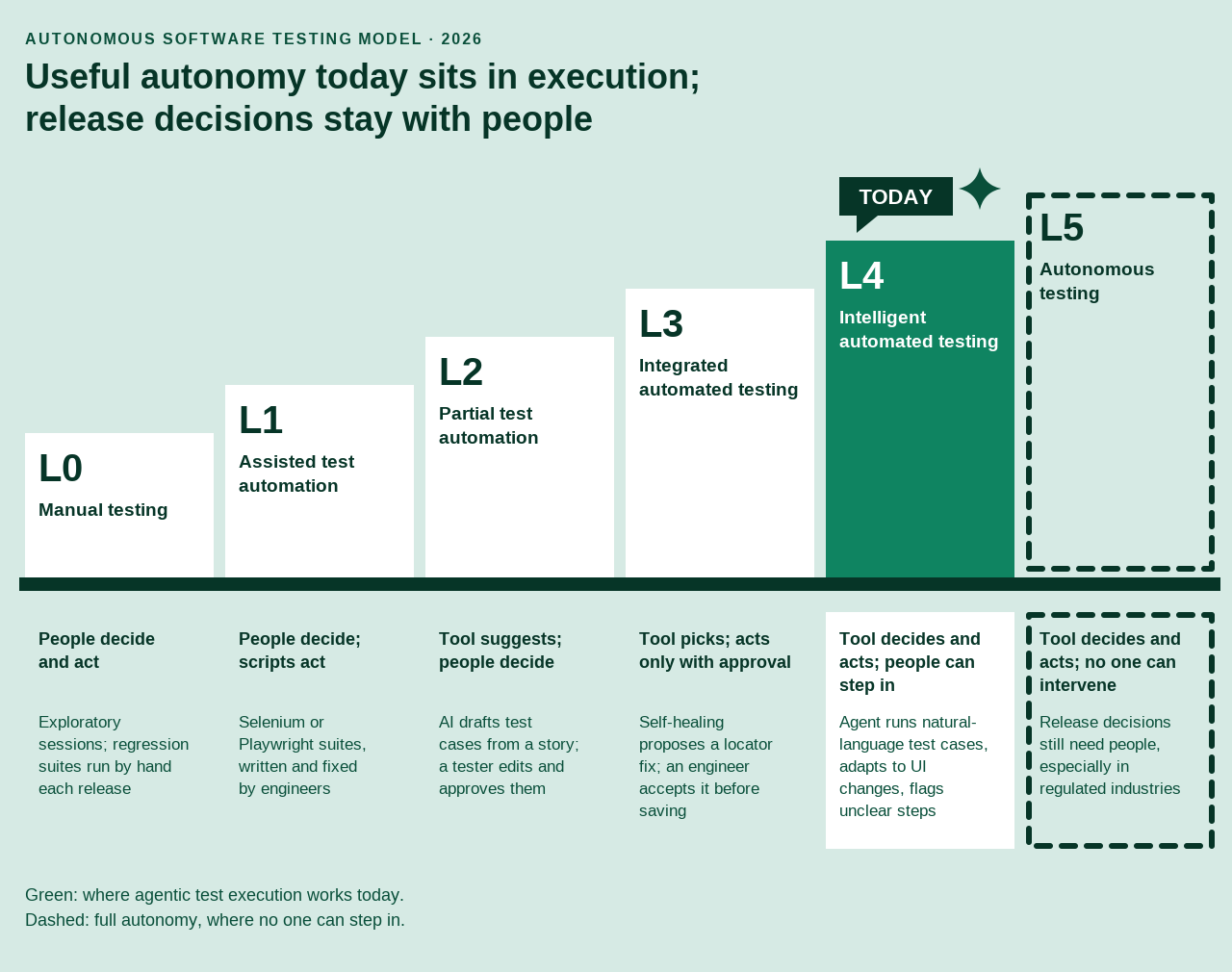
The ASTM in 2026
In 2022 we said the industry was at around Level 2. That's no longer true. Agents that run natural-language test cases, adapt to UI changes and judge each step with evidence put useful execution at Level 4 today.
Level 5 needs a closer look. The original model defined it as a system where "human intervention is not possible." For running test steps, that's close to where agents already are. For deciding what to test and whether a build ships, it's the wrong goal. Release decisions carry business risk, and in regulated industries someone has to be accountable for them. The EU AI Act, for example, requires human oversight of high-risk AI systems.
So the levels don't apply evenly to the whole testing job. A team can run execution at Level 4 while keeping test planning at Level 2 and the release decision with people. That's the setup we recommend.
For the full original model, read the ASTM paper. For a look at how far the industry got by 2024, see Autonomous Testing: Are We There Yet?
How Autonomous Testing Works Today
Autonomous testing in 2026 comes down to five capabilities. Few tools do all five well, so it helps to check each one separately.
1. Executing Natural-Language Test Cases
The agent reads a test case written for a person, with steps and expected results, and runs it against the app. There's no script to write and no locator to maintain. This is the most mature capability today, because the test case already tells the agent what "correct" looks like.
2. Exploring an App
Given a goal such as "complete a checkout as a guest," the agent finds its own path through the app. Exploration is useful for finding broken flows and building a map of the app, but its findings need a person to judge which ones matter.
3. Self-Healing
When a button moves or an ID changes, the agent finds the element by what it is and what it does rather than by a fixed locator. Self-healing has been around in scripted tools for years; agents extend it from a single locator to a whole step.
4. Test Generation
Agents can draft test cases from requirements, user stories or app behavior. The drafts still need a reviewer, because a generated test can only be as good as its source. See autonomous test generation and how to review AI-generated test cases.
5. Evidence-Backed Reporting
Every verdict comes with proof: what the agent did, what it saw and why it passed or failed the step. This is the capability that decides whether the other four are usable, because a result nobody can check is a result nobody should ship on.
Where Autonomous Testing Works, and Where It Doesn't
Autonomous testing works best on checks that have a clear right answer. If the expected result can be written down ("the order total shows $42.50," "the user lands on the dashboard"), an agent can carry out the steps and compare the outcome reliably.
It works least well on judgment. Is this layout confusing? Is this error message acceptable for a bank customer? Is a 3-second delay a bug or fine for this flow? Those calls depend on context the agent doesn't have, and they're where testers earn their keep.
Good fit for an agent | Keep with people |
|---|---|
Regression suites with written expected results | Exploratory testing and usability |
Repeated cross-browser and cross-device runs | Deciding what to test for a new feature |
Data-driven tests with many input rows | Judging severity and business impact |
Flows whose UI changes often | Go or no-go on a release |
Can You Trust Autonomous Test Results?
You can trust an autonomous test result as far as you can check it. A green status from an agent is a claim; the evidence behind it is the proof. Before you rely on any tool, ask whether every result answers these questions:
- What did it do? A step-by-step record of actions, not a summary.
- What did it see? Screenshots or video for each step.
- Why this verdict? The expected result next to the actual one, and the reasoning that connects them.
- Who checked it? Whether the agent judged its own work or something independent did. An agent that grades itself has an obvious conflict, which is the argument in The Agent Passed Its Own Test. That's the Problem.
- What happens when it's unsure? A good agent stops and asks a person rather than guessing a pass.
Will Autonomous Testing Replace Testers?
No. Autonomous testing takes over the repetitive part of the job, running the same steps release after release, and leaves people with the decisions that need experience and context. Katalon's research on this is in Will AI Replace Manual Testers?, and the shift in the tester's role is covered in Manual Testers Are Getting Promoted.
How to Get Started With Autonomous Testing
Start small, run the agent beside your current process, and expand only where the evidence holds up.
- Pick a stable, well-written regression suite. Choose tests that already pass reliably and that a new teammate could follow without asking questions.
- Tidy the expected results. Vague expectations ("page loads correctly") give the agent nothing to check. Rewrite them as observable outcomes ("the order confirmation number is shown").
- Run the agent and a person in parallel for two cycles. Keep your current process as the baseline while the agent runs the same tests.
- Compare verdicts and evidence. Look at every disagreement. Each one tells you whether the test case, the app or the agent needs fixing.
- Expand by risk. Move the low-risk, high-repetition suites first. Keep high-risk flows under closer review until the agent has a track record on them.
Autonomous Testing With Katalon
Katalon AI Test Runner brings autonomous execution to the manual test cases your team already has. It runs in Katalon TestOps, part of the Katalon True Platform, and works from natural-language test cases with steps and expected results.
Here's what a run looks like:
- Start it where your tests live. Run a test case, a test suite or a manual test run from Katalon TestOps, on a schedule, or from Katalon AI Assistant. It can also be started from an AI assistant connected through the Katalon MCP server.
- Check readiness first. Before the run, the AI reviews each test case for missing or unclear steps, so a tester can fix gaps once.
- Run in parallel. Independent test cases run in parallel on Katalon Test Cloud, against web apps in Chrome or Edge and against mobile apps.
- Verify every step. A separate AI checks the evidence for each step before giving a verdict. If a step is unclear, the runner hands it to a person rather than passing it.
- Keep the proof. Every result has video, screenshots and the AI log for each step. Failed steps show the expected and actual result, and you can raise a defect in Jira or Azure DevOps from the result.
On the ASTM, AI Test Runner works at Level 4 for execution: it decides how to carry out each step and adapts when a screen changes, with a person able to step in. Deciding what to test and whether to ship stays with your team. That's by design.
To see how it works on your own test cases, read the AI Test Runner launch post or request a free trial.
Frequently asked questions
Automated testing runs a script that a person wrote in advance, step by step. Autonomous testing gives an AI agent a goal or a test case and lets it decide how to carry out each step at run time. The agent adapts when the app changes and records evidence for every verdict.
They overlap. Agentic testing describes how the work is done: AI agents that plan and take actions toward a goal. Autonomous testing describes how much of the decision-making the agent takes on, measured in levels. Most agentic testing tools today operate at Level 3 or 4 of the ASTM.
Fully autonomous testing, where no person can intervene, isn't a sensible goal for release decisions. Agents can carry out test execution with little help today. Deciding what to test, judging business impact and approving a release should stay with people, especially in regulated industries.
Yes, in part. API tests already have clear inputs and expected responses, which suits automation well. Agents add value by generating API test cases from specifications and by adapting tests when an endpoint changes, but most API testing today is still scripted and run in CI.
Autonomous test generation is when an AI agent drafts test cases from requirements, user stories or app behavior. It speeds up test design, but every generated test needs a reviewer before it joins a suite.





Test everything. Ship with confidence.
From generating test cases to spotting failures, Katalon's AI works across your entire pipeline, automatically.
