


In 2022, Katalon introduced the Autonomous Software Testing Model (ASTM): six levels of autonomy for software testing, inspired by the SAE standard for driving automation.
Update, November 2026: This post introduced the ASTM in 2022. For how the model applies today, read What Is Autonomous Testing? It covers what agents can now do at each level and why decisions about what to test and whether to ship should stay with people.
We've been thinking long and hard about software testing and automation here at Katalon. We've noticed a shift in the software testing industry from test automation to Autonomous Software Testing (AUST). By "autonomous," we mean software testing in which Artificial Intelligence (AI) and Machine Learning (ML) take on more of the decisions and actions in testing, with less human direction at each level of autonomy.
We figured the industry shift from test automation to AUST could either be messy, a sort of Wild West approach to product maturation, or goal-driven: something the entire software testing community could aspire to in a spirit of cooperation. That's where self-driving cars, or autonomous vehicles as the mobility industry calls them, come in.
The measured advances in autonomous vehicles have inspired us to assemble a way to benchmark progress toward autonomy in the software testing domain. We call the benchmark the Autonomous Software Testing Model (ASTM).
We wanted a way to gauge just where software testing platforms are in their development of "self-driving" software testing — Katalon included. We looked to the Society of Automotive Engineers for guidance on building an ASTM benchmark.
Building a Software Testing Benchmark
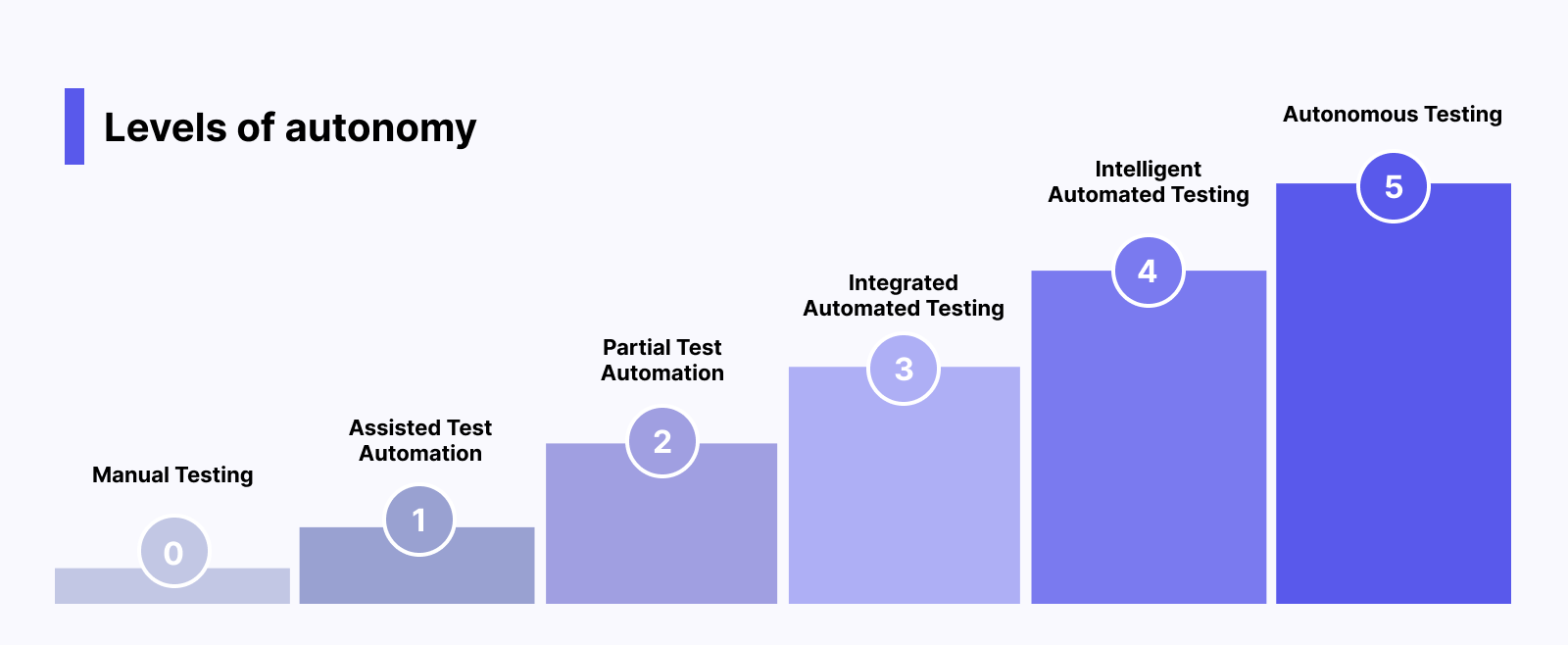
The benchmark for the maturation of autonomous vehicles that the Society of Automotive Engineers (SAE) created observes that humans will be involved in the evolution of the technology as a matter of course. In other words, autonomous vehicles will not suddenly pop out of a black box overnight. Instead, humans will be involved with developing, training, and testing the technology for some time to come.
The ASTM model, then, sets out six stages of human-machine integration. Zero (0) represents full manual design and implementation of testing procedures. The highest level, Five (5), sees full AI/ML design, implementation, and decision-making of tests:
Level 0: Manual Testing
The human performs all activities and actions and makes all decisions concerning testing of the System Under Testing (SUT).
Level 1: Assisted Test Automation
The human performs most actions for testing the SUT with the support of the computer, e.g., automated software tools. The computer carries out certain testing actions automatically under the human’s control. The human holds the main role and makes all testing decisions.
Level 2: Partial Test Automation
Both the human and the computer perform testing actions and generate possible decision options, but the human still makes most testing decisions. The computer carries out testing actions based on the decisions made by the human.
Level 3: Integrated Automated Testing
The computer generates a list of decision options, selects an option, and performs actions based on this option if the human approves. The human can also select another decision option for the computer to carry out.
Level 4: Intelligent Automated Testing
The computer generates decision options, determines the best option, and performs testing actions according to this option. The human can still intervene if necessary.
Level 5: Autonomous Testing
The computer has full control of the testing process for the SUT, including making decisions and carrying out all testing actions. The human cannot intervene.
The Software Testing Lifecycle
We felt we needed to ground the ASTM even more soundly in the software testing cycle. Defining each stage of software testing would enable us to apply the benchmark to software testing platforms on the market. We identified the nine activity areas that define software testing as:
- Test Management (TMN)
- Test Orchestration (TOR)
- Test Maintenance (TMA)
- Test Generation (TGR)
- Test Optimization (TOP)
- Test Monitoring (TMO)
- Test Execution (TEX)
- Test Management (TMN)
- Test Evaluation and Reporting (TRE)
Autonomous Software Testing Model Self-Assessment
We applied the ASTM benchmark to Katalon. We scored the Katalon functionality on a spider diagram to gauge the degree to which Katalon has evolved its autonomous features.
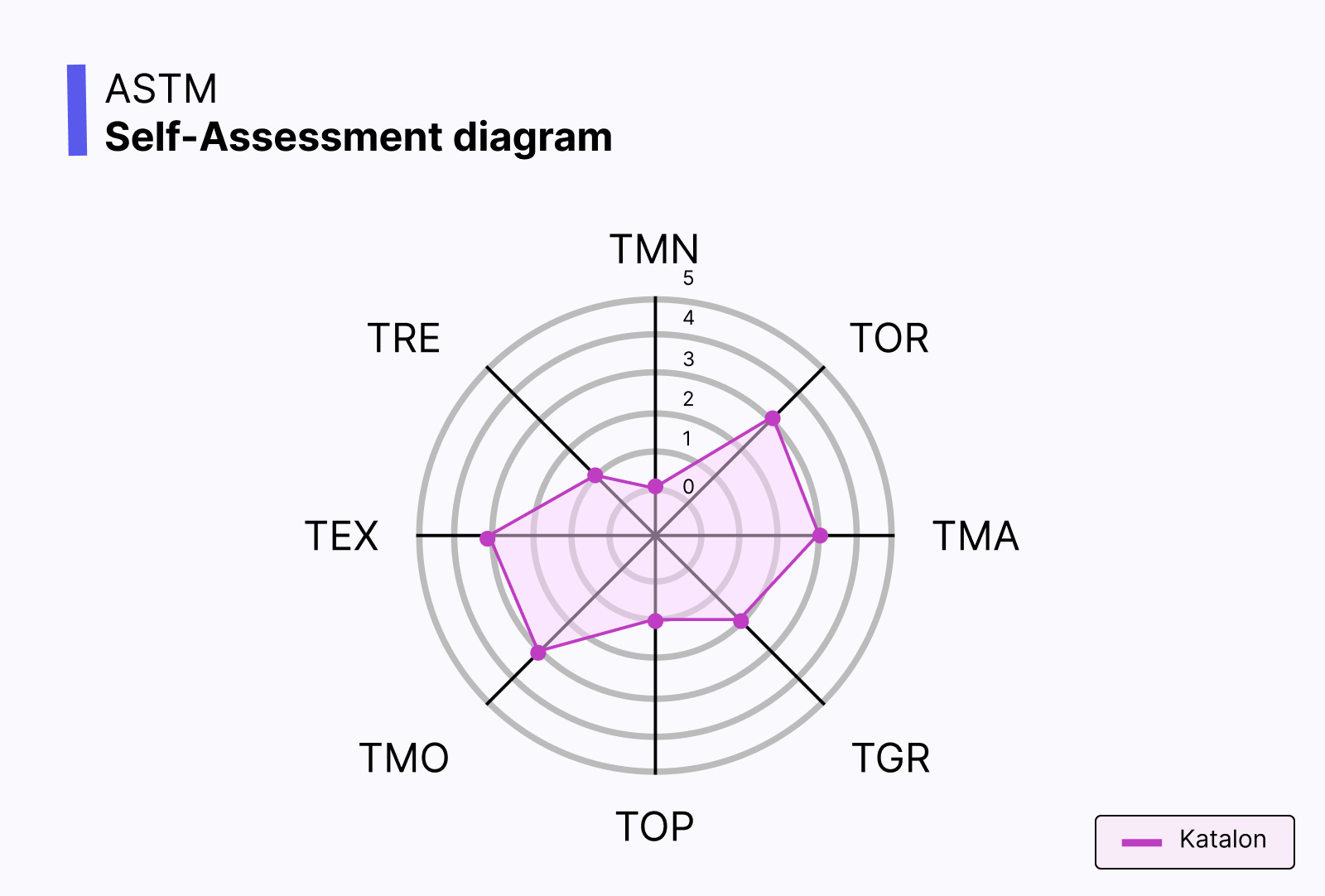
In our 2022 assessment, Katalon rated 3rd-level autonomous activity in the areas of Test Orchestration (TOR), Test Maintenance (TMA), Test Monitoring (TMO), and Test Execution (TEX). The benchmark implies that while the Katalon Platform could generate a list of decision-testing options for these activities, the system still required human approval to act on the options; or, instead, the human can select another decision option for Katalon to act on.
If you are a Katalon user, where would you place our platform's levels of autonomy?
If you would like to learn how Katalon's AI-powered capabilities can speed up software deployment, increase the accuracy of your testing, and reduce overall development costs, contact us for a demo.
Download our academic paper entitled "Autonomous Software Testing Model" for a fuller description of the ASTM benchmark. The paper also includes:
- Full descriptions of the software testing lifecycle activities
- Charts that cross-reference ASTM stages with standard testing activities
- A look at how the ASTM benchmark gauges other software testing platforms
More to read:
Frequently asked questions
The Autonomous Software Testing Model (ASTM) is a benchmark created to measure progress toward Autonomous Software Testing (AUST)—testing that is fully driven by AI and ML with no human intervention. Inspired by the Society of Automotive Engineers’ model for autonomous vehicles, ASTM defines stages of autonomy so the software testing community can track and compare maturity in a structured way.
ASTM defines six stages of human–machine integration, from Level 0 to Level 5: Level 0 – Manual Testing: Humans perform all actions and decisions. Level 1 – Assisted Test Automation: Tools support the human, but humans still do most actions and make all decisions. Level 2 – Partial Test Automation: Both human and computer act; the human still makes most decisions. Level 3 – Integrated Automated Testing: The computer proposes options and acts on a selected option with human approval, or based on an alternative option chosen by the human. Level 4 – Intelligent Automated Testing: The computer chooses and executes the best option, with humans still able to intervene. Level 5 – Autonomous Testing: The computer has full control over decisions and all testing actions, and humans cannot intervene.
To ground ASTM in real workflows, the model is applied across nine activity areas, including:Test Management (TMN), Test Orchestration (TOR), Test Maintenance (TMA), Test Generation (TGR), Test Optimization (TOP), Test Monitoring (TMO), Test Execution (TEX), and Test Evaluation and Reporting (TRE). These areas allow platforms to be evaluated for autonomy in specific parts of the testing lifecycle.
Katalon’s self-assessment using ASTM shows Level 3 (Integrated Automated Testing) autonomy in areas such as Test Orchestration (TOR), Test Maintenance (TMA), Test Monitoring (TMO), and Test Execution (TEX). At this level, the platform can generate decision options and act on them with human approval, or execute an alternative option chosen by a human tester.
QA teams can use ASTM to gauge how “self-driving” their testing platforms really are, compare capabilities across tools, and plan how to move from lower to higher autonomy levels. They can also dive deeper by downloading the “Autonomous Software Testing Model” academic paper, which includes full lifecycle activity descriptions, cross-reference charts, and examples of how ASTM can be used to evaluate different testing platforms, including Katalon.





Test everything. Ship with confidence.
From generating test cases to spotting failures, Katalon's AI works across your entire pipeline, automatically.
