


Four reasons enterprise test automation fails, based on survey data from over 1,400 quality professionals, and what successful teams do about each one.
Enterprises invest heavily in test automation to release faster, cover more, and cut costs. But in Katalon's State of Software Quality Report 2025, a survey of over 1,400 quality professionals, many teams said they struggle to get the full value from it.
The core problem is a skills gap. 68% of respondents see automation scripting as key to success, yet 51% say their teams have limited automation skills.
Here are the four biggest challenges, and what successful teams do about them.
Four reasons enterprise test automation fails

Survey responses from quality leaders and practitioners across industries and company sizes point to four main obstacles.
1. Too much time spent on maintenance
In large enterprise systems, small UI or API changes can break automated tests. 38% of enterprise teams say they struggle to implement and maintain test automation well. Teams end up fixing old tests instead of writing new ones, and automation delivers less value.
2. Limited speed and scale
Enterprise apps need testing across many platforms. 56% of QA teams prioritize performance and scalability testing, but 30% say their current tools fall short at scale. Without parallel execution and cloud-based testing, test cycles run long and slow down development.
3. Poor visibility
Nearly 30% of respondents are in leadership roles, and they need to see what's happening in testing. 24% of organizations say their reporting and analytics aren't good enough. Without clear reports, debugging takes longer and releases slip.
4. Not enough expertise
51% of organizations say their teams have limited automation skills. The gap hurts most when key people change roles and automation work stalls. Tools that need a lot of scripting also make it hard for nontechnical team members to help. That's why 67% of organizations see continuous learning and upskilling as key to reaching their quality goals.
How to fix it
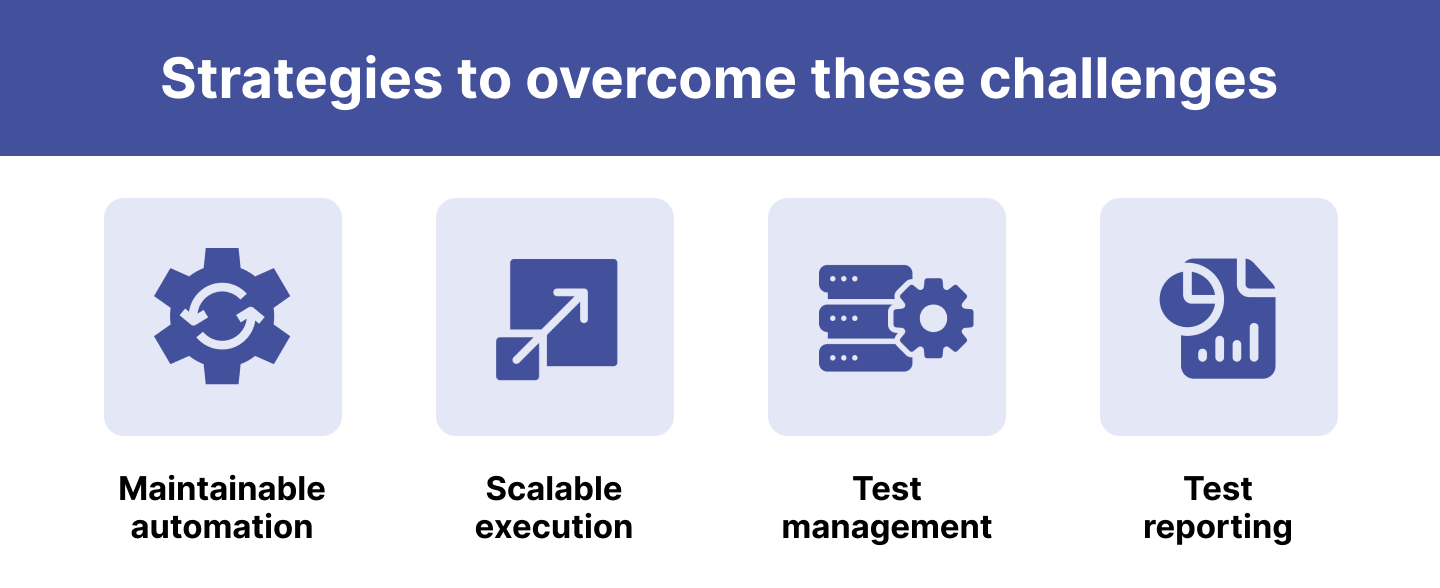
Teams that succeed with automation tend to focus on three areas.
Build automation that's easy to maintain
High maintenance cost is the top challenge for 40% of teams. Frequent app updates need a test design that handles change without constant rework.
That takes more than better scripts. Design your framework to evolve with the application. Successful teams use reusable components and modular frameworks, so tests keep working as systems grow. Features like self-healing tests also cut the time spent fixing broken locators.
Scale test execution
48% of organizations plan to adopt more advanced CI/CD tools. Teams are moving past basic automation to parallel execution, cloud infrastructure, and containerized testing, which turns a slow, one-at-a-time process into one that scales.
Improve test management and reporting
71% of respondents say ease of use is their top factor when choosing a tool. That ease needs to reach beyond test creation. Successful teams focus on:
- Central dashboards with real-time views of test runs and results
- Root-cause analysis that helps teams find and fix issues fast
- CI/CD integration that puts quality data in front of everyone in the pipeline
Together, maintainability, scale, and visibility give automation a solid base. One more step makes the difference: breaking down silos.
Break down testing silos
Many enterprises test web, mobile, and API in separate tools with separate approaches. That leads to gaps and inconsistent results. A single approach across platforms closes coverage gaps, makes testing simpler and more reliable, and means fewer tools to maintain. With more than half of teams prioritizing performance and scalability testing across platforms, a single view of quality matters even more.
The path forward
Successful test automation needs a plan that covers people and process, not just tools. Teams that invest in both tools and skills adapt faster to new testing challenges and ship better software, faster.
Conclusion
Enterprise test automation is hard, but the path is clear. Teams that succeed focus on four things: less maintenance, scalable execution, better visibility, and stronger skills. Combine the right tools with ongoing training, and automation becomes a source of business value instead of a cost.
Katalon True Platform helps with all four: low-code test creation and self-healing in Katalon Studio, parallel cloud runs on Katalon Test Cloud, and central reporting in Katalon TestOps. For more data, download the State of Software Quality Report 2025.

Frequently asked questions
Four obstacles come up most: time spent maintaining brittle tests, tools that don't scale, weak reporting, and gaps in automation skills.
Small UI or API changes can break many tests at once, and 40% of teams say high maintenance cost is their top challenge. Teams end up fixing old tests instead of writing new ones.
Use parallel execution, cloud infrastructure, and containerized testing, and connect tests to your CI/CD pipeline.
Central dashboards, root-cause analysis, and CI/CD integration show leaders what's happening in testing. Without them, debugging takes longer and release decisions get delayed.
67% of organizations see continuous learning and upskilling as key. Invest in training, and choose tools that let technical and nontechnical team members work together, so automation doesn't stall when experts leave.





Test everything. Ship with confidence.
From generating test cases to spotting failures, Katalon's AI works across your entire pipeline, automatically.
