


Independent consultant Bas Dijkstra explains why test automation exists to deliver valuable feedback fast, why self-healing tools can't fix a communication problem, and why engineers stay accountable for tests even when AI writes the code.
A conversation with Bas Dijkstra, independent test automation consultant and trainer, on why test automation exists to deliver valuable feedback, fast, and why no tool, AI included, can fix a people problem for you.
The Quality People series has so far heard from practitioners inside product teams and from the engineers who build testing tools themselves, including Huy Tieu, Gastón Marichal, and Minh Huy Dao. This time we talked to someone who answers to no employer at all.
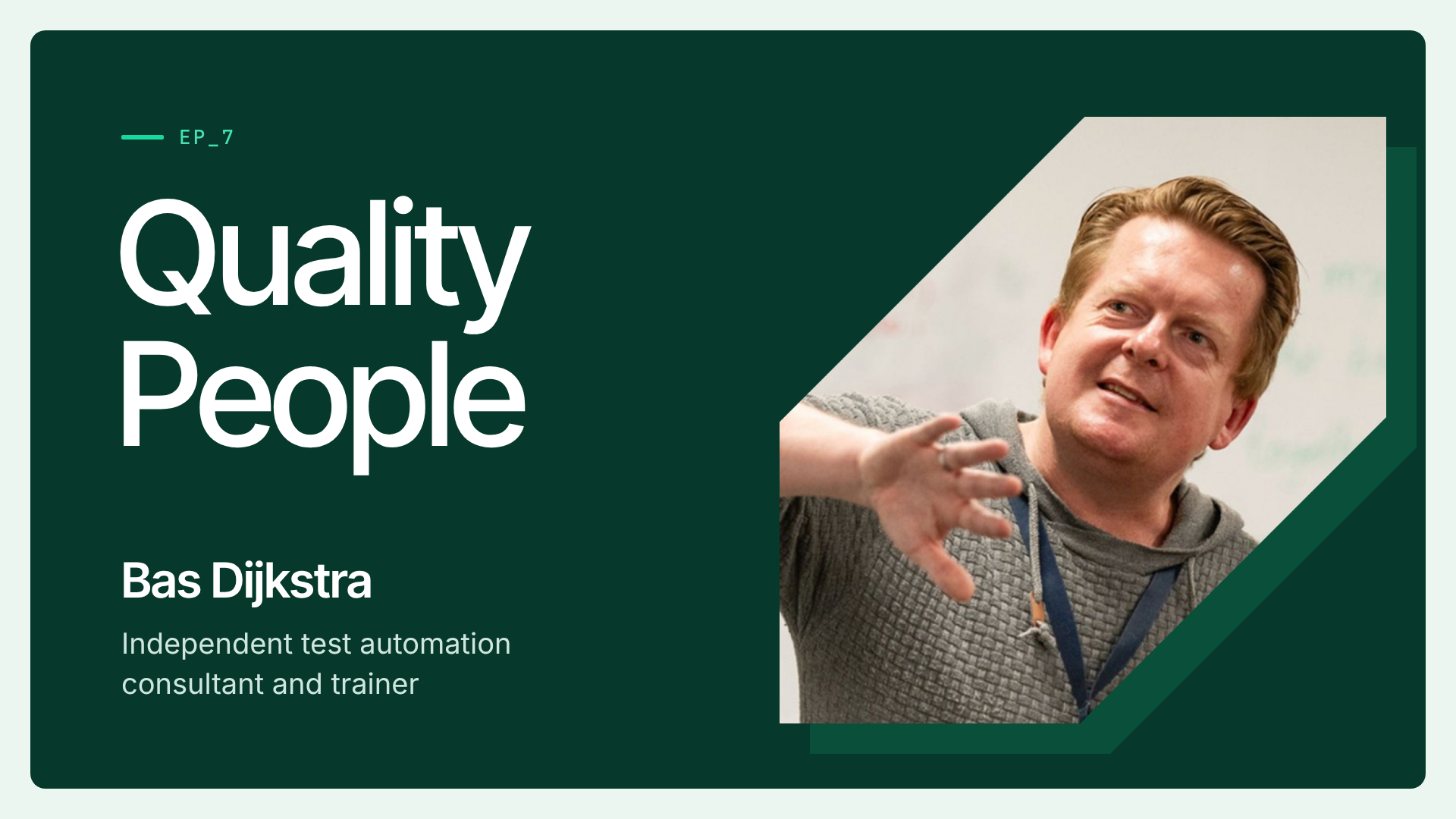
Bas Dijkstra has spent just over 20 years in test automation, the last 12 as an independent consultant and trainer based in Amersfoort, the Netherlands. He has trained hundreds of people, built the open-source C# library RestAssured.Net, and argued in public that test automation is about valuable feedback, not vanity metrics.
We asked him to defend some of those arguments, and pushed back on a couple of them. He did not soften anything.
Being His Own Boss and Traveling the World
Asked what an ordinary week looks like, Bas admits there is no such thing anymore, and that is the point.
“My working weeks are a mix of preparing for and delivering workshops and training sessions, consulting with clients, speaking at a meetup, conference or in-company event, writing for my newsletter and blog, and running mentoring or pair programming sessions. It’s hard to say what an ordinary week looks like these days, because my schedule varies significantly from one week to the next.
“I like that variety, which is why I stopped taking on full-time engagements a few years ago - I would simply get bored doing one thing for too long at a time.”
Going independent, he says, opened doors that would have stayed closed to him as an employee.
“Going independent has opened quite a few doors for me that would probably have remained closed to me if I would have stuck to being an employee. Now that I’m independent, I can reach out to and work with companies my former employers would have never even been in touch with.
“To sum it up, the beauty of being independent, for me, is that I get to decide entirely on my own what I want to work on and whom I want to work with.”
“Valuable Feedback, Fast”: Simple but Not Easy
One phrase runs through almost everything Bas writes and teaches. We asked where teams lose sight of it, and what they chase instead.
His fix starts before anyone writes a line of automation code:
“Before you decide to ‘automate a test case’, I think it’s good to take a step back and ask yourself and others two questions:
“The result is often a rewrite of the test cases to make them fit for automation.”
Then there is coverage, which he could not leave out. Our piece on rethinking coverage covers related ground.
“Too often, measuring the value of test automation degrades into chasing vanity metrics. Code coverage, number of test cases automated, that kind of metrics. However, just because you’re doing a lot of something doesn’t mean that that activity is actually valuable. As a crude example, I can easily write tests that realize a very high level of code coverage, but that don’t assert on the right things and therefore those tests will not detect meaningful changes in product behavior. I don’t think that’s where we should want to be.”
Self-Healing Tests and the Communication Problem
Bas wrote recently that self-healing test tools are a band-aid over the real problem, which the question framed as nobody on the team knowing the locator had changed. We asked him to make that case, then answer the harder version: what should a team do when the product really does change that fast?
He started by questioning the premise.
“First, I assume that at least someone knew that a locator might change when the frontend code is updated - the developer who made and committed that change. If they didn’t realize it, you would have a whole different kind of problem on your hands. But again, let’s assume they did.
“In any case, to me, it seems like there’s a communication problem in this team, and failing to communicate that a locator has changed might just be one example of a deeper problem here. In my experience, communication problems are not solved by throwing tools at them - they’re solved by improving communication.”
For fast-moving products, he points to two levers. The first is to question how much of the suite needs the UI at all, an idea that connects to the test pyramid. The second is to shorten the loop between the person changing the product and the person changing the test.
“If a product does change fast - and that’s the case for many products these days - I think there are two things that a team needs to look into.
“First, I think it would be wise to see if they really need all the GUI-driven tests that they have. That might lead to a reduction in your dependency on GUI-driven tests, which makes the problem we’re talking about here smaller.
“Second, shorten the feedback loops. First, shorten the communication lines between the person changing the product and the person changing the test. If they’re different people, try making them pair up and update the product and the tests at the same time.
“Another technique to shorten feedback loops is to have your GUI-driven tests that are related to the change run on a pre-commit hook, for example, so that changes to locators in your tests are detected before the change to the product even reaches version control.
“In any case, do not try to patch up a communication problem with a tool.”
When the Dashboard Is the Deliverable
Plenty of testers work somewhere that rewards green checkmarks. We asked how someone starts to shift that when the dashboard is what their manager reads.
“I too do recognize that unfortunately, a lot of what we do in test automation, and in software testing in general, has been watered down to generating and executing test cases in pursuit of some percentage of ‘test cases automated’, or some form of coverage. Somewhere down the line, we stopped asking the more important questions, such as
- What do we need to know about our product before we merge / deploy / release?
- Is this the most efficient way to get the information that we’re looking for?
- What decisions are we comfortable making based on the feedback provided by our automated tests?
“The way to correct course and shift from chasing vanity metrics (back) to a test suite that is providing valuable feedback, fast is to start - and to keep - asking those questions.”
His most practical advice is about how you phrase the case for change:
“In any sufficiently large test suite, there’s bound to be room for improvement. Make a note not just of what is missing, but also what the impact to the product, the process, or both is. Don’t just say The assertions for these tests are rather weak, say Here’s a change in product behavior that would slip past our tests undetected.
“Another example: don’t just say We have too many end-to-end tests, say We could break down this test into smaller, more efficient tests this way, getting the same feedback faster.
“The key is to provide evidence of what would visibly and measurably improve with regards to the product, the process, or both, when you advocate for a change. Remember that no business wants to spend time or money on testing, but every business wants a high-quality product. Frame your ideas and recommendations that way, and you’ll have a much better chance of actually making a change for the better.”
AI Writes the Code, but Who Is Accountable?
Bas has argued for years that learning test automation properly means learning software development: design patterns and object-oriented thinking, not just syntax. Has AI writing the code changed that?
“I don’t think the importance of learning and understanding the fundamentals of software design and development as a test automation engineer has changed much, really.
“What has changed, of course, is the mechanics of writing the test code. When you give it the right tools, and as long as you put the right guardrails in place, an LLM is capable of writing pretty decent test code for you, in seconds.
“What is still very much our responsibility as engineers, is to figure out what feedback we’re looking for, exactly and where to get that feedback. An LLM is very capable at efficiently writing tests that might look good at first glance, but that do not provide the feedback that is valuable to us.
"We, as engineers, as humans, will remain accountable for the product we put into the hands of our users, and I think it would be prudent (as well as our professional duty) to remain responsible for understanding the system and its behavior. I don’t think you can do that without a good understanding of the code, of design patterns, and of object-oriented thinking, among many other things.”
His AI Usage Non-Negotiables
Bas used Claude Code to refactor RestAssured.Net, with his own handwritten tests as the safety net. That is a more specific position than most people hold, so we asked where AI earns its place in his work and where he refuses it.
“I’m still more comfortable having AI writing product code for me than asking it to write test code, though. I think it is my responsibility to deeply understand the tests, the product behavior that they verify and whether I can rely on the feedback that these tests give me, and writing tests myself, or at least being closely involved in the process, helps me to trust the tests.”
That last point is worth sitting with. Bas is more comfortable letting AI write product code than test code, because the tests are where the intended behavior of a product gets defined.
For background on the other side of that choice, see our guide to AI testing.
The Misconception He Corrects in Hour One
Bas has trained hundreds of people. We asked what he finds himself correcting in the first hour of almost every workshop.
“One theme that does come up in pretty much every workshop at some point (and often quite soon) is that the tool or technique that we’re covering is going to magically solve all our testing and automation problems.
- Deciding to use Playwright will not magically solve the automation problems that your Selenium-based suite had.
- Introducing contract testing will not magically solve the problems that come with a more traditional approach to integration and end-to-end testing in distributed systems.
- Adding AI to your testing and automation strategy will not magically solve any of your testing and automation problems, period.
“Sure, that new tool or technique might help you get to where you want to be, faster. In the end, though, Gerald Weinberg’s second law of consulting applies pretty much everywhere:
“‘No matter how it looks at first, it’s always a people problem.’”
What 20 Years Changed His Mind About
We closed by asking what he has changed his mind about. He offered three, with the caveat that the list is far from complete.
“I have changed my mind about many things since I started working in test automation, sometimes even multiple times over. Here are just a couple of examples, this is not a complete list.
“Developers can’t test - I used to believe that only testers were capable of doing good testing, and that we were somehow the only guardians of quality. That couldn’t be further from the truth. One of the things that makes a great developer is being a good tester, too. A good developer takes pride in building a quality product, and testing is an important part of that, and they know it.”
“Tools are inherently good or bad - There are a lot of tools out there, and most of them, especially those that have been around for a little bit longer, are good tools. A tool, by itself, doesn’t make or break your test automation efforts.”
“Our job is to automate everything / all the (regression) tests - I’ve mentioned this a few times already, but this perception keeps rearing its rather ugly head. My first couple of assignments as a test automation engineer were literally to ‘automate all the test cases’. It didn’t work. The moral of the story, though, is that our job as testers and as test automation engineers is to provide valuable feedback, fast, and to use tools to help us do so efficiently. That’s it.”
And on AI, he sees a familiar pattern:
“In 20 years, I’ve seen many tools, techniques and approaches come and go. Things will always change in our profession, which is one of the things that has kept me interested in test automation, but many things also don’t change nearly as much as you think.”
“AI is a prime example here. Yes, it has a significant impact on how we work, but it hasn’t really changed what we do and why we do it. It is a powerful, interesting and sometimes deceptive tool that, in the hands of a skilled person, can provide a lot of value. That has been true for many tools I’ve seen enter the field in the past.”
What to Ask Your Team This Week
Strip away the specifics and Bas’s advice comes down to a few questions any team can ask in its next planning session. What do we need to know about our product before we merge, deploy, or release? Is this the most efficient way to get that information? What decisions are we comfortable making based on the feedback our automated tests give us?
Twenty years in, Bas keeps returning to the same idea because, as he sees it, much of the field has drifted away from it. Coverage percentages, automated test counts, self-healing locators, and now AI-generated suites can all look like progress on a dashboard.
His test is simpler: does the suite tell you something worth knowing about the product, quickly enough to act on it, and do you understand it well enough to trust it? If the answer is no, the fix is rarely another tool. It is usually a conversation.
You can find Bas’s writing on his website, subscribe to his newsletter, or browse RestAssured.Net and his other projects on GitHub. For more conversations like this one, read the rest of the Quality People series, starting with Fariz on why fundamentals still beat tools.
Frequently asked questions
Bas says the purpose of test automation, and of software testing in general, is to provide valuable feedback about the state of the product in an efficient manner. He sums it up as "valuable feedback, fast." It sounds simple because it is, but simple is not the same as easy. Before you automate a test case, he suggests asking what information you are really looking for and what the most efficient way to get it is.
A self-healing tool can patch a broken locator, but it cannot explain why nobody on the team knew the locator would change. Bas sees that as a symptom of a communication problem between the people who change the product and the people who maintain the tests, and he argues that communication problems are solved by improving communication, not by adding tools. His alternatives are to reduce your dependence on GUI-driven tests and to shorten feedback loops, for example by pairing on product and test changes or running related GUI tests on a pre-commit hook.
No. Bas says the responsibility for writing tests may have shifted to an LLM, but the accountability has not. Engineers remain accountable for the product that reaches users, so they still need to understand the system and its behavior, which takes a solid grasp of code, design patterns, and object-oriented thinking. An LLM can write tests that look good at first glance but do not give you the feedback you actually need.
Bas is still on the fence. He uses AI as a rubber duck for workshop outlines and is comfortable with it writing product code, but he writes the tests for RestAssured.Net himself, because tests define the intended behavior of the product and he wants to understand them well enough to trust their feedback. His firm rule is to never use AI for tasks he does not understand or could not have done himself, since he has to be able to scrutinize the output. For more background, see our guide to AI testing.
Start asking better questions and keep asking them: what do we need to know about our product before we merge, deploy, or release; is this the most efficient way to get that information; and what decisions are we comfortable making based on the feedback our automated tests give us. Bas points out that you can reach very high code coverage with tests that do not assert on the right things, so they will never detect meaningful changes in product behavior. Our piece on rethinking coverage covers related ground.
Show the impact on the product, the process, or both, and bring evidence. Instead of saying the assertions are weak, point to a change in product behavior that would slip past your tests undetected. Instead of saying you have too many end-to-end tests, show how a test could be broken into smaller, more efficient tests that give the same feedback faster. As Bas puts it, no business wants to spend time or money on testing, but every business wants a high-quality product, so frame your recommendation that way.
Not on its own. Bas corrects this assumption in almost every workshop: moving to Playwright will not magically fix the problems of a Selenium-based suite, contract testing will not fix every integration problem in a distributed system, and adding AI will not fix your testing problems either. In his view there is no such thing as a bad tool, only a bad fit for a specific context, and, quoting Gerald Weinberg, it is always a people problem.





Test everything. Ship with confidence.
From generating test cases to spotting failures, Katalon's AI works across your entire pipeline, automatically.
