


A test automation proof of concept shows whether a tool fits your project before you invest at scale. Learn why POCs matter, six steps to run one, what to include in the template, and how to move to a pilot project.
A proof of concept in automation testing deserves thorough preparation and implementation to validate the automation initiative. Done right, it gives the QA team valuable insights to make timely adjustments before scaling automation.
What Is a Proof of Concept (POC) in Automation Testing?
Proof of Concept (POC) is a broad technical term used in various industries. Teams and companies use a POC to prove that their idea works in real-world environments. A POC is essential in the decision-making process because its results can be informative enough to point out potential issues before they happen.
For example, imagine that you are calling for investment on your potential business idea. However, investors hardly believe in plain words unless you have evidence for your success. This is when a POC is necessary to showcase your action plan in a small scale environment.
A POC in automation testing is usually conducted when the team wants to adopt a new automation testing tool. As part of the first phase of the automation transformation, the team may run a POC after evaluating and selecting an automation tool.
Why Is a Proof of Concept Necessary in Automation Testing?
For Testing Projects
Although QA teams may have spent a lot of time on tool evaluation, an Automation Testing POC is the final step to test and challenge all the assumptions. There are certain aspects related to automation that a well-designed POC can help verify, including:
- The difference between manual testing and automation testing in terms of outcomes and test quality
- The capability to meet the testing requirements of the automation tool
- What can and cannot be tested automatically
- How much automation testing saves compared to manual testing
- The predicted ROI of test automation in the long run
- Hidden issues of the projects that require changes
Implementing an automation solution takes time and considerable monetary resources. Instead of jumping right into that process, conducting a POC will get the plan audited in a short time with much less effort.
For Stakeholders
As mentioned earlier, stakeholders are the other group that needs a clear POC in addition to QA teams. Without the POC, business owners and investors may venture blindly into the unknown.
Financial viability matters to every business, and an automation testing POC shows decision-makers whether the planned automation solution is viable and can deliver a healthy ROI. It is also an excellent way for investors to evaluate the projects they are about to fund.
With all these benefits, a POC helps teams and businesses get the most out of automation testing instead of wasting the investment.
How to Implement a Proof of Concept in Automation Testing
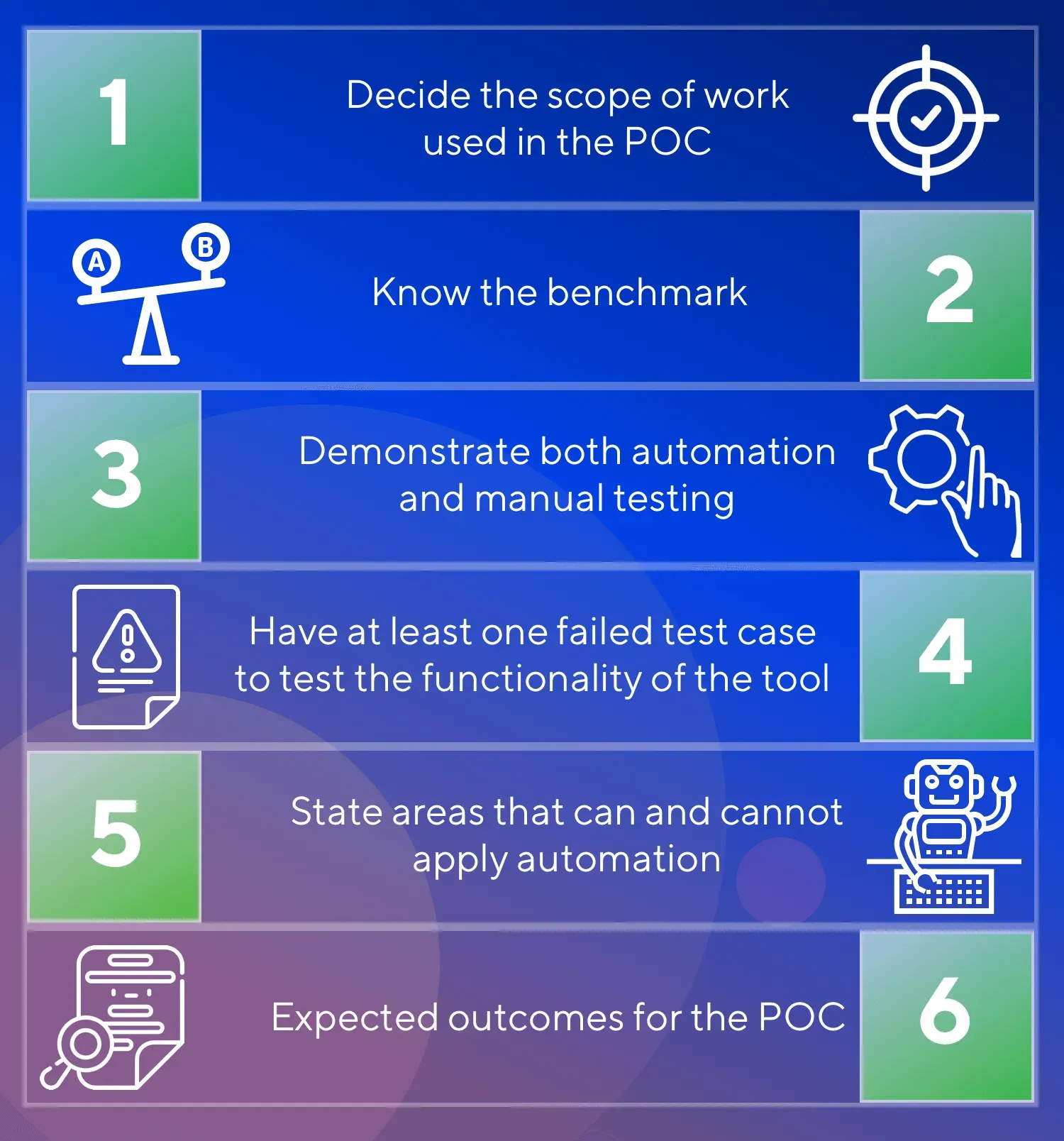
1. Decide the Scope of Work for the POC
It is unnecessary to cover all test cases of the project in a POC. Instead, the team should pick up some of the most critical test cases. They can be core functions of the software or features that end users will be most interested in.
2. Know the Benchmark
The team should be able to benchmark the POC results against the current testing state. Knowing the current baselines will help with the comparison later on.
3. Demonstrate Both Automation and Manual Testing
It should be shown in the POC that there is no degradation in the test quality delivered by automation.
4. Include at Least One Failing Test Case
Ideally, a POC needs to have at least one test case that fails, meaning it results in finding a software defect. A proper automation testing tool must find out the flaw in such cases.
5. State Which Areas Can and Cannot Be Automated
- Although the POC aims to prove the automation tool’s value, it should also show which parts of the testing workload cannot be automated.
6. Define Expected Outcomes for the POC
Setting up a set of requirements for the POC in advance will help analyze the results after completion. There are some key factors that an automation testing POC should highlight:
- Can the automation tool automate all the intended features of the application?
- Can the automation tool run on all browsers required by the project?
- Will automation require changes to the app’s implementation?
Template for an Automation Testing POC
The standard template for an automation testing POC varies on a case by case basis. In general, it should cover:
- A set of requirements for the POC outcomes
- Candidates of the POC (Selected automation tools in this case)
- Project requirements
- Pros and cons of each automation tool according to the project requirements
- POC results
Evaluate the Results of an Automation Testing POC

After conducting a POC, there are three possible scenarios for the team to take into consideration.
- The tool satisfies the project requirements: The tool can be considered feasible for real-world implementation. However, any issues found while running the POC should be carefully assessed and addressed.
- The tool does not satisfy the project requirements: The automation initiative should be canceled or postponed for further evaluation.
- The tool partially satisfies the project requirements: The team needs more data to make a final decision and may choose to revise its project requirements.
In the first scenario, once the POC confirms the tool’s feasibility and management approves it, the next step is a pilot project.
Conduct a Pilot Project
Basically, a pilot project creates a real-world environment to test a solution with minimum expenses. In automation testing, a pilot project is necessary to challenge the approved POC when it is applied in reality.
A standard pilot project for test automation should include these five steps:
- Defining test cases for pilot
- Developing automation framework
- Scripting and executing
- Reporting
- Maintaining automation scripts
Conclusion
Once the automation testing POC and pilot project are completed, their results come into practice. With insights gathered from the POC, the decision-maker can have a better data-driven approach to their automation transformation process.Trigger modal
Frequently asked questions
A short, focused exercise to validate that a chosen automation tool and approach can meet your project’s real-world needs. It proves feasibility, exposes hidden issues, and quantifies potential ROI before full rollout.
It verifies tool capability against requirements, clarifies what can/can’t be automated, compares manual vs. automated outcomes, estimates time/cost savings, and gives decision-makers evidence of financial viability—avoiding costly missteps.
Scope: Select a few critical, high-value test cases. Benchmark: Capture current manual baselines for fair comparison. Dual runs: Show both manual and automated results (no quality degradation). Intentional fail: Include at least one failing case to prove defect detection. Boundaries: Clearly list areas suitable/unsuitable for automation.
Confirm the tool automates the targeted features, runs on all required browsers/environments, meets quality and performance benchmarks, and note any app changes the tool would require. Document results in a simple template: POC goals, candidate tools, project requirements, pros/cons per tool, and final results.
Meets requirements: Proceed to a pilot. Doesn’t meet: Re-evaluate tool/approach or pause the initiative. Partially meets: Gather more data or refine requirements.A pilot should then cover: selecting pilot test cases, building the automation framework, scripting/execution, reporting, and ongoing script maintenance.





Test everything. Ship with confidence.
From generating test cases to spotting failures, Katalon's AI works across your entire pipeline, automatically.
