


What are microservices, and when should you use them? Learn how microservices differ from monoliths, their key benefits, how they work, stateless vs. stateful services, greenfield vs. brownfield adoption, and the role of containers.
Microservices are an architectural style for building software that has steadily gained popularity. The term emerged among software architects around 2011, was popularized by James Lewis and Martin Fowler’s 2014 article, and has been adopted by companies such as Netflix, Amazon, Uber, SoundCloud, and eBay.
So, what are microservices? What are their benefits? And why have so many large enterprises built them into their DevOps and continuous testing strategies?
We’re going to break down these concepts and give you a better understanding of how they work. Read on to find out!
What Are Microservices?
Before jumping into the definition, let’s start with the early edition of microservices: monoliths.
Microservices evolved from traditional monolithic architecture. Large monolithic systems can be a burden to maintain and update. An approach that worked well with Waterfall development often struggles to keep pace with today’s Agile, Kanban, and Scrum teams, especially as applications grow.
Microservices, or microservices architecture, are the modern methods of designing software applications that compartmentalize the software into chunks of small and independent services.
The core idea is simple: instead of building one large codebase that is deployed as a single unit, microservices split the application into smaller services that can be built, deployed, and scaled independently.
The main benefit? Microservices enable rapid, frequent delivery of large, complex applications while improving reliability.
Purpose of Microservices
Microservices matter to teams that waste time digging through massive codebases, which can feel like finding a needle in a haystack.
When beginning to code a new product, working with a monolithic style is often a more natural approach to building up the codebase. The product is smaller and not as complex as more established products.
However, once the product becomes denser and more complicated, working with a microservices style is a great way to make the code easier to maintain. After all, adding new features or fixing a bug in the main codebase in a monolithic application can often trigger new bugs in another part of the code.
Transitioning from the larger monolithic codebase and establishing microservices makes it easier to pinpoint errors that may arise when adding new features or bug fixes. Knowing it can only be in a small section of code saves time for both the testers locating the bugs and developers for fixing the error.
Benefits of Microservices
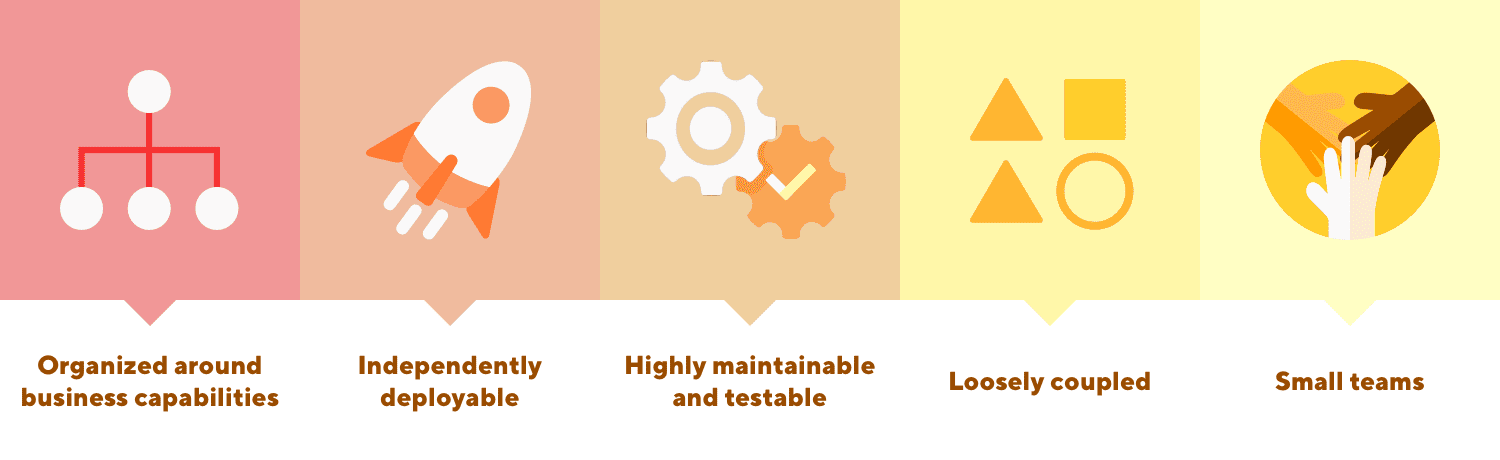
Organized Around Business Capabilities
Business capabilities are actions that businesses take to bring value. These actions are often structured around business objects, such as order and customer management, product and service development, demand generation, amongst others.
Independently Deployable
Each service can be deployed independently, which means less time is needed to retest the entire application for changes made to one specific service.
Highly Maintainable and Testable
As each service is independent of the other, making changes to that service would not affect the rest of the product’s codebase, resulting in easier maintenance and faster testing.
Loosely Coupled
Microservices structures an application as a set of loosely coupled services, minimizing the dependencies of one service to another.
Small Teams
Engineering is organized into small, autonomous teams, often of about 6 to 10 people, with each team responsible for one or more services.
How Do Microservices Work?
Microservices break each part of the codebase into multiple modular and loosely coupled components, through which each service performs one or more functions.
Each service should be aligned with business capabilities to ensure you are meeting each function’s requirements. These individual functions can be distributed across clouds and data centers and treated as an independent service, therefore allowing each to be changed, updated, or deleted without putting the rest of the application at risk.
Communication between services is important for smooth interaction. Microservices use APIs and communication protocols to work with each other. Placing services behind an API gateway simplifies interaction, improves efficiency, reduces coding effort, and lowers the risk of errors.
Whether starting from scratch and building a product using microservices right away or transitioning from a monolithic legacy application, microservices are a great way to have an easily maintainable and scalable product. With greater agility to create new features and fix bugs quickly, your product can get to market faster than the competition and also please your customers with quick updates.
Types of Microservices
In general, there are two types of microservices:
Stateless
Stateless services act as the foundation of many distributed applications. They don’t store session state between requests, so any instance can handle any request, and instances can be scaled, replaced, or removed without affecting the rest of the application. Stateless microservices are recommended for most distributed systems.
Stateful
Stateful microservices keep track of state, such as session or transaction data, across requests, usually by storing it in a database or cache. Stateful services are a good fit when session information needs to be retained.
Microservices Implementation Approach

Beginning a new product has many challenges, one of which is how to organize your application’s codebase. Will you start with a monolithic architecture because you anticipate the product to be simple? Or do you think it will quickly transform into complex features that could benefit from a microservices architecture from the start?
Consider these two approaches to microservices as a part of your strategy.
Greenfield
The greenfield approach is when you begin microservices architecture from scratch. This is the best approach when developing a system in a new environment as there is no legacy system to integrate.
This approach is a higher risk, as is building any new infrastructure, and it’s best to use Agile software development to accommodate that risk. Using an Agile technique allows you to handle any risks by fully developing one service of the product at a time so that immediate feedback may be obtained (either internally or externally).
Brownfield
The brownfield approach is used when transitioning an existing monolithic legacy application to microservices architecture.
This approach tackles microservices in stages (otherwise, it would be considered greenfield), so make sure you have a strategy in place before beginning. Decide which part of the application to start with, then work incrementally until each service has been created.
Microservices and Containers
Microservices are easiest to create and maintain when each service runs in an isolated container. Using cloud capabilities, you can run the service anywhere in a predictable environment. Each container is a self-contained package with only the libraries and executables that specific service needs.
Working with many containers requires a container orchestration tool to manage the application as a whole. Docker is the most common way to build and run containers, and Kubernetes is the leading platform for orchestrating them.
Containerization makes it easy to test each service independently without running tests on the entire application. This significantly cuts test time, so you can get the product or new feature into end users’ hands faster. And if something goes wrong with a service, that container alone can be stopped and fixed, or replaced entirely.
Conclusion
Microservices offer many benefits and have been widely adopted by large Agile enterprises. However, they are not a one-size-fits-all solution for every software development problem.
So keep this in mind: Before beginning a transition to microservices, make sure to fully evaluate if it is the right choice for your company. The transition process is time-consuming and expensive.
If the product generates revenue with a steady stream of users, then you should consider microservices. When the product inevitably expands to accommodate more users and features, the codebase will expand and make the monolithic architecture even more tedious to maintain. Therefore, microservices can be a great investment for your company if it has the revenue to justify the expense and assure stakeholders of beneficial returns.
×
Frequently asked questions
Microservices (microservices architecture) design software as small, independent services, rather than one monolithic application, often splitting one large code repository into several smaller repositories.
Large monolithic systems become burdensome to maintain and update; microservices make it easier to maintain code, pinpoint errors, and reduce the risk of new changes triggering bugs elsewhere.
Organized around business capabilities, independently deployable, highly maintainable and testable, loosely coupled, and supported by small autonomous teams (often 6–10 members).
They use APIs and communication protocols, and placing services behind an API gateway can make interaction easier while improving efficiency and reducing coding effort and error risk.
Stateless services don’t maintain session state between requests; stateful services store session information to maintain request state when services communicate.





Test everything. Ship with confidence.
From generating test cases to spotting failures, Katalon's AI works across your entire pipeline, automatically.
