


Continuous delivery and continuous deployment both automate your release pipeline. The difference is whether a person approves each release. Here's how they compare and how to choose.
Most teams know the term CI/CD pipeline. The confusing part is the "CD". Does it mean continuous delivery or continuous deployment? How do the two differ, and which one fits your team?
This guide covers both definitions, the key differences, and how to choose.
What is continuous delivery?
Continuous delivery is a practice where every code change is automatically built, tested, and prepared for release to production. Before a change is ready, it must pass automated unit testing, integration testing, and system testing.
The move from continuous integration to continuous delivery is usually automatic, with automated testing at the unit, integration, and system levels.
Automated tests give more thorough validation. Developers can find and fix issues before a release goes public. Paired with an automated release process, they give you a dependable, repeatable pipeline.
With releases waiting in staging, teams can ship whenever they choose with a single click. The key point: a person decides when to release. As Martin Fowler puts it, continuous delivery means you can deploy at any time, not that you must.
What is continuous deployment?
Continuous deployment goes one step further. Every change that passes the automated pipeline is released to production automatically, with no human approval. Users get new changes as soon as they're ready.
Teams need to prepare well for this. Development and IT teams need production-ready environments, strong test coverage, and solid release practices.
Before release, code runs through automated tests in staging environments that mirror production. After release, teams monitor the live environment in real time to spot and fix issues quickly.
Continuous delivery vs. continuous deployment: key differences
Continuous delivery keeps software ready to release, with a manual approval step. Continuous deployment removes that step and releases changes automatically once tests pass.
So what does the CD in CI/CD stand for? The answer is both. Teams pick the practice that fits their workflow and product.
Continuous delivery suits companies that want a final check before changes reach users. It also suits regulated work: test the build with automation testing tools, then have the QA team review it before release.
Continuous deployment is a stricter form of continuous delivery. Every build must pass all tests, and the test suite must be strong enough to approve builds for release on its own.
Both practices rely on real-time infrastructure and application monitoring to catch issues that testing missed. Research from DORA links these practices to faster, more stable software delivery.
Comparison table
Aspect | Continuous delivery | Continuous deployment |
|---|---|---|
Definition | Keeps software always ready for release by automating build and test | Releases changes to production automatically once they pass automated tests and quality checks |
Best for | Teams that want frequent, planned releases | Teams that release new features daily or several times a day |
Automation | Highly automated, with a manual approval step | Fully automated, with no human approval before production |
Release frequency | Regular, often on a schedule | Very frequent, often several times a day |
Risk management | Rigorous testing, with room for manual checks | Depends on strong automated testing and QA to keep bugs out of production |
User feedback | Can be slower, since releases are scheduled | Faster, since changes reach users quickly |
Rollback | Often needs manual coordination | Usually quicker, since small changes can be reverted through the same pipeline |
Team collaboration | Still important, with more time to coordinate and validate | Developers, testers, and operations must work closely |
Adoption | Easier to start, since teams can automate step by step | Needs mature automation across development and deployment |
Culture | Focus on automation, continuous improvement, and Agile | Trust, collaboration, and strong DevOps practices |
Use cases | Regular release cycles where stability matters most | Fast-moving products such as web apps and SaaS |
Benefits of continuous delivery
Continuous delivery means teams release small changes often. Several small releases are usually easier to manage than one large release every few weeks.
Users accept small changes more easily than big ones. Small changes are also more stable and easier to control.
Tests can fail at any level and in any environment. So your CI/CD pipeline needs a fast feedback channel that reports failures to developers. Keep these loops short. Developers can then add non-critical failures to the backlog and fix critical ones right away.
Katalon TestOps helps here. It gives you shared test reports across teams, so you can see where tests failed and find bugs faster. It also schedules test runs for you.
Benefits of continuous deployment
Continuous deployment works when teams rely on automated infrastructure to make each step fast and reliable. Manual testing doesn't fit here, because it slows the pipeline down.
With a fully automated pipeline, the team no longer has to plan big releases. They also get feedback straight from users on each change.
Continuous deployment vs. continuous delivery vs. continuous integration
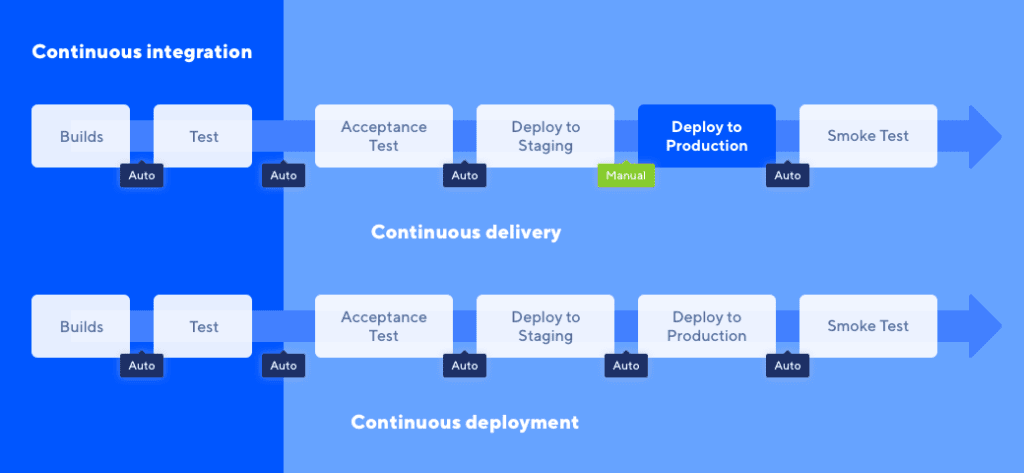
Continuous integration (CI) is a related practice. Developers merge code into a shared repository often, and automated tests run on each change. This catches integration issues early and keeps the codebase working.
A typical CI/CD pipeline starts with CI. Code is tested continuously, developers avoid duplicate work, and changes merge into the codebase smoothly.
After CI comes continuous delivery. Changes go through fixes and feedback before reaching a production-like environment. The team then decides what to release and when.
Continuous deployment takes the last step and removes human approval. The two practices differ, but they share a goal: an automated, efficient release process. Some teams use both, for example by deploying low-risk changes automatically and holding others for manual approval.
Learn more in our guide to CI and CD benefits.
CI/CD done right with Katalon Studio
Whether you choose continuous delivery or continuous deployment, both help your team ship updates regularly and keep customers happy.
The most important part is to test the pipeline continuously and thoroughly. Then the workflow moves on to release, deployment, operations, and monitoring, so you can spot anything that needs fixing.
Katalon Studio is a continuous testing solution built for test automation in CI/CD and DevOps. It supports web, API, mobile, and desktop testing on Windows, macOS, and Linux. You can record test steps, run test cases, view reports, and connect to your CI/CD tools in one place.
Frequently asked questions
The difference is human approval. Continuous delivery keeps code ready for production but needs someone to approve each release. Continuous deployment releases code to production automatically once it passes all tests.
It depends on your goals and readiness. Choose continuous delivery if you want control over release timing and manual checks. Choose continuous deployment if you want fast, automated releases and have mature test automation.
Teams building fast-moving products, like web apps or SaaS platforms. They often release several times a day, need real-time feedback, and have strong automation and monitoring.
Teams choose continuous delivery when they need more control over when features go live, manual QA checks before release, or scheduled releases that match business or compliance needs. It's common in regulated industries.
Both rely on automated testing and monitoring. Continuous delivery leaves time for manual testing before release. Continuous deployment needs automated tests strong enough to stop failures before they reach users. In both, real-time monitoring catches issues after release.
Yes. Many teams start with continuous delivery and move to continuous deployment as their automation matures. Some pipelines use both, deploying some changes automatically and holding others for manual approval.





Test everything. Ship with confidence.
From generating test cases to spotting failures, Katalon's AI works across your entire pipeline, automatically.
