


Boundary value analysis (BVA) is a black-box testing technique that targets the edges of input ranges, where defects tend to cluster. Learn how it builds on equivalence partitioning, with examples and best practices.
Boundary Value Analysis (BVA) is a core software testing technique that focuses on testing the boundaries or edges of input ranges. It is based on the observation that errors often occur at the edges of input ranges rather than in the middle. By testing the extremes, BVA helps identify potential vulnerabilities and ensures that the system behaves correctly at its limits.
Since boundary value analysis is closely related to equivalence class partitioning (ECP), let's start with ECP first, then move on to BVA.
What Is Equivalence Class Partitioning?
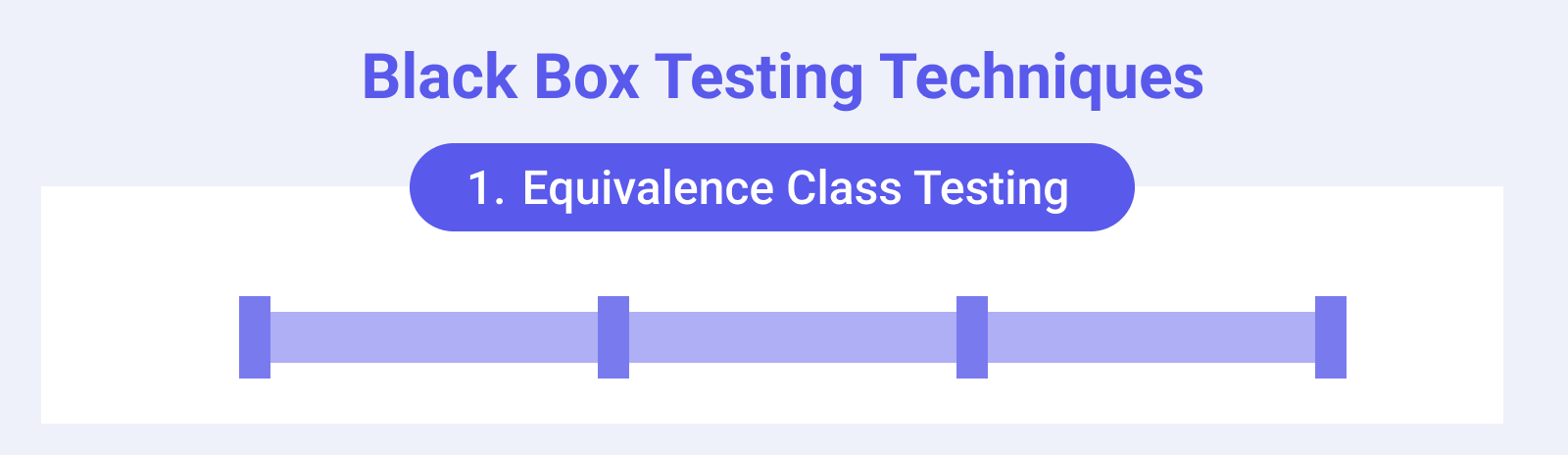
Equivalence Partitioning Testing is a black-box testing method that divides input data into equivalent sets. The idea is that if one condition in the group passes or fails, the entire group will behave similarly. This significantly reduces the number of test cases while ensuring adequate test coverage.
Suppose you're testing a function that validates a user's age for an online registration form, with a valid age range of 18 to 60 years.
Here’s how you could create equivalence classes:
- Valid Equivalence Class: Ages 18 to 60 [18-60]
- Invalid Equivalence Classes:
- Ages less than 18: [-∞ to 17]
- Ages greater than 60: [61 to ∞]
- Non-numeric inputs: ["abc", "#$%", etc.]
Now, let's select representative values from each class:
- Valid class: 25 (within the valid range)
- Invalid classes:
- Less than 18: 17
- Greater than 60: 61
- Non-numeric: “abc”
From these, we can generate the following test cases:
- Test Case 1: Age = 25 (Expected: Valid)
- Test Case 2: Age = 17 (Expected: Invalid)
- Test Case 3: Age = 61 (Expected: Invalid)
- Test Case 4: Age = "abc" (Expected: Invalid)
What Is Boundary Value Analysis?
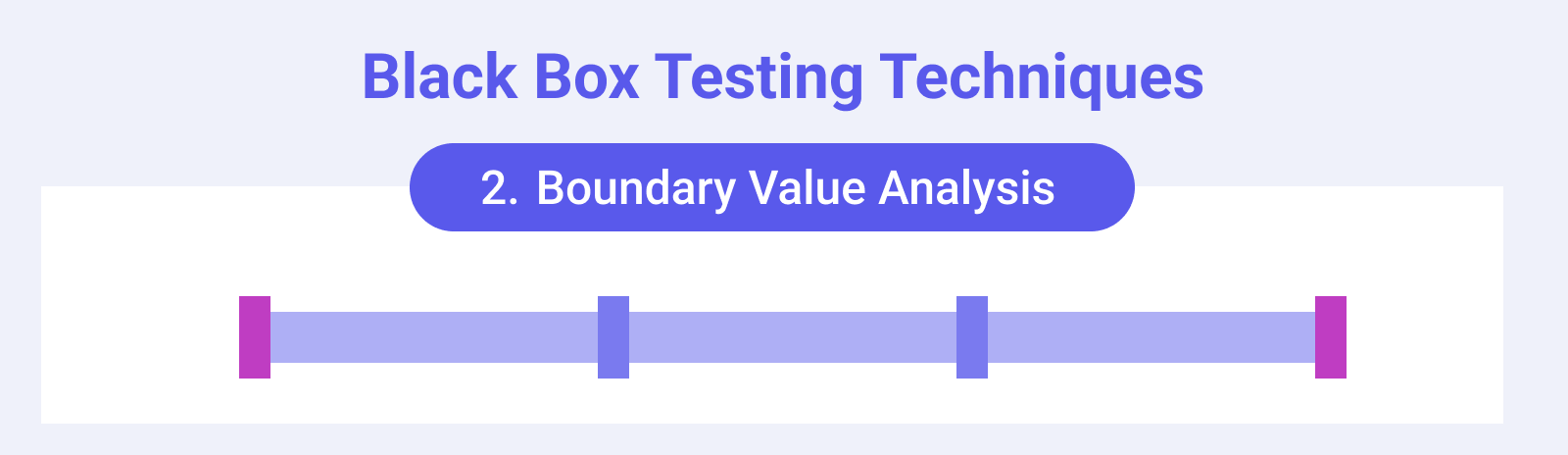
Boundary Value Analysis is a black-box testing method that aims to test the boundaries between equivalence classes. While Equivalence Class Partitioning only divides inputs into valid and invalid groups, BVA takes this a step further by testing only extreme values just below, just above, and at the defined boundaries. This helps ensure the system properly handles edge cases, which are often where software failures occur.
Let's go back to the previous example. You're testing a function that validates a user's age, with a valid age range of 18 to 60 years. We have the following equivalence classes already defined:
- Valid Equivalence Class: [18–60]
- Invalid Equivalence Classes:
- Ages less than 18: [-∞ to 17]
- Ages greater than 60: [61 to ∞]
- Non-numeric inputs: ["abc", "#$%", etc.]
Boundary value analysis focuses on testing the boundaries of these ranges.
- Just outside the lower boundary: 17
- At the lower boundary: 18
- Just above the lower boundary: 19
- Just below the upper boundary: 59
- At the upper boundary: 60
- Just outside the upper boundary: 61
You now have 6 critical test cases, which cover the key points where errors are likely to occur.
Why Boundary Value Analysis Is Important
Testing within the range of valid inputs alone may not reveal issues that occur at the system’s extremes. For example, if the form accepts ages from 18 to 60 but fails to handle edge cases like 17 or 61 correctly, users may encounter problems at these boundaries. BVA ensures these edge cases are properly tested.
Going Beyond Simple Boundaries
Boundary value analysis doesn’t stop at obvious boundaries. Consider more extreme cases to ensure thorough coverage. For instance, what happens if someone enters an age of -3, 9,999,999, or a non-numeric value like “twenty-five”? Work with developers to understand how edge cases are handled in the code, so your boundaries are tested effectively.
Boundary Value Analysis Best Practices
Here are some best practices to follow when performing Boundary Value Analysis:
1. Identify Equivalence Classes
Begin by identifying the valid and invalid input ranges for your system. For instance, in the age validation example, the valid class is [18-60], and the invalid classes are those above 60, below 18, or non-numeric inputs.
2. Determine Boundaries
Once the equivalence classes are established, determine the boundaries for each class. For the age validation example, boundaries include 17, 18, 19, 59, 60, and 61.
3. Select Test Cases
Choose values that are at, just below, and just above each boundary. This ensures that edge cases are covered, where errors are most likely to occur.
How to Choose Values Above and Below Boundaries
When selecting values for boundary testing, consider how far above or below the boundary you should test. For example, if your input range is divided into multiple segments (e.g., [0-30], [31-60], [61-90]), selecting a value just above the boundary at 30 might mean crossing into the next range. Ensure that your selected boundary values are meaningful and within the context of the system.
Boundary Value Analysis vs. Equivalence Partitioning
While Equivalence Class Partitioning (ECP) focuses on grouping inputs into valid and invalid sets, Boundary Value Analysis takes this a step further by concentrating on the "edge" or boundary points of those sets. In a way, BVA is ECP taken to a more granular level. Testing just a few values at the edges often reveals more errors than testing random values within the middle of a class.
Conclusion
Boundary Value Analysis is an essential testing method that ensures systems behave correctly at the edges of input ranges, where errors are most likely to occur.
Frequently asked questions
Boundary Value Analysis (BVA) is a software testing technique (often part of black-box testing) that focuses on testing input values at the edges of defined ranges. These “boundary” values—just below, at, and just above the valid limits—are where defects are most likely to show up
Equivalence Class Partitioning (ECP) groups inputs into valid and invalid classes and tests representative values within them. BVA takes it further by testing the boundary values of those classes—for example, test 17, 18, 19 (if valid range is 18–60)
Usually 6 test cases per boundary: Just below the boundary (e.g. 17) At the boundary (e.g. 18) Just above the boundary (e.g. 19)Same applies at upper boundary—so for one field you might test: 17, 18, 19, 59, 60, 61
Yes. BVA works for ranges defined by character length, dates, enumerated types, or even non-numeric boundaries. You simply identify the edge conditions inside and outside the valid set (e.g. string length limits)
Because errors commonly occur at the boundaries of input ranges (like a programmer using > instead of >=). BVA is efficient—using few test cases to catch critical defects—and enhances test coverage without testing every value
BVA may be less effective alone if non-boundary invalid inputs (e.g., symbols, negative) are not tested. When input ranges depend on other inputs (like age limit varying by gender), BVA alone may miss logic variations
Use metrics such as: Boundary Value Coverage (percentage of boundary values tested) Equivalence Class Coverage Defect density/severity, to see how many defects are caught near boundariesThis helps assess how thorough and effective your BVA is





Test everything. Ship with confidence.
From generating test cases to spotting failures, Katalon's AI works across your entire pipeline, automatically.
